
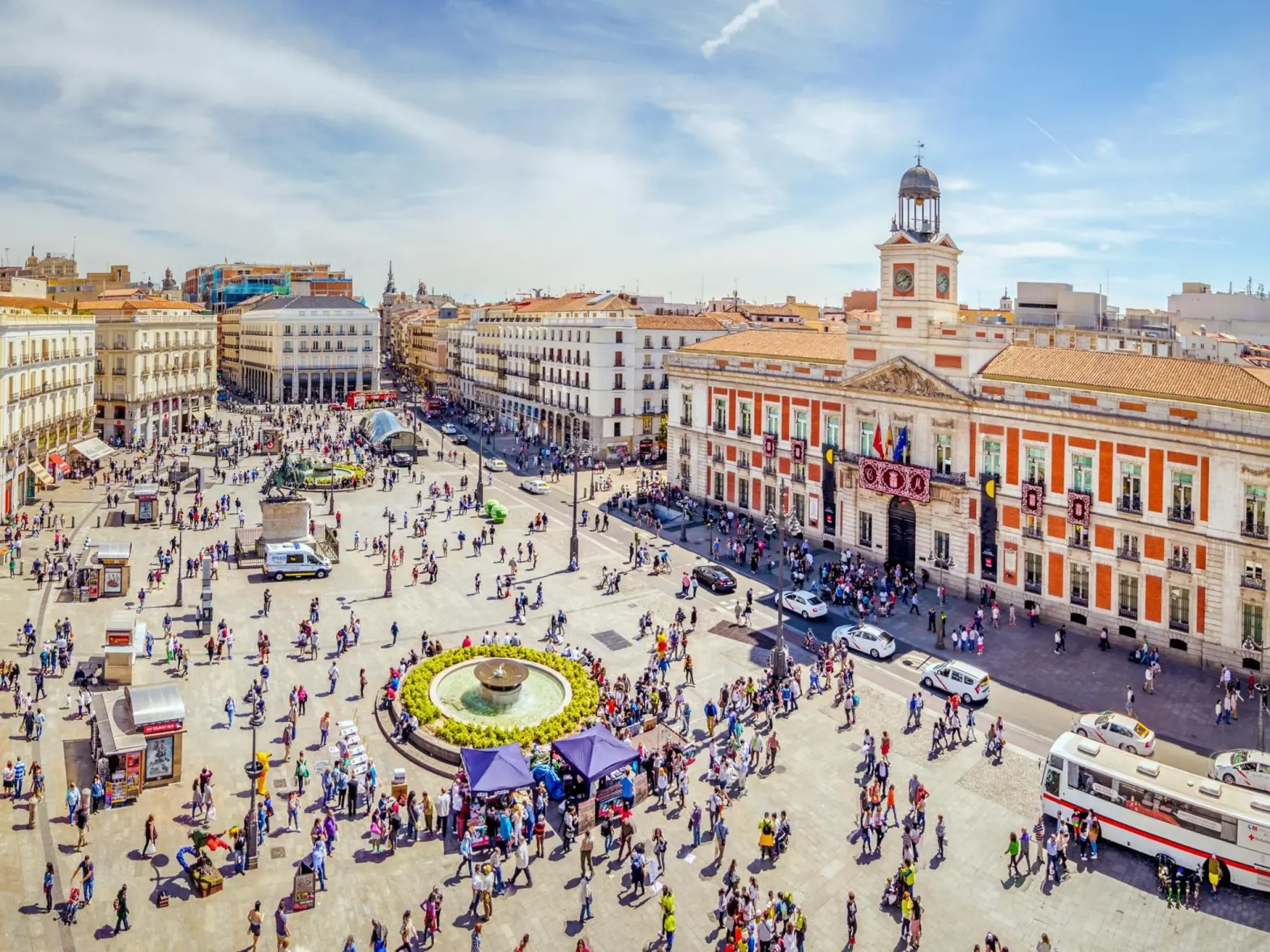
HISTORY OF MADRID
Madrid is the capital of Spain and the Community of Madrid. Known also as the Villa and Corte, it is the largest and most populated of the country. As it is the capital city of the State, in Madrid we can find the seats of government, the Cortes Generales, ministries, institutions, as well as the official residence of the king and queen of Spain. It is the main financial and business centre nationwide. It is the third largest stock market in Europe and the second in the Latin American sphere. Madrid also houses several of the world biggest companies.
Due to the recent discovery of a Visigothic burial and other pre-Roman and Carpetani archaeological remains, the origin of the city is being revised. These discoveries prove various authors’ theories, which hold that there is a later Muslim hill fort (Maǧrīţ, 9th century), constructed over a Visigothic vicus form the 7th century called ‘Matrice’ (meaning stream).
We have to wait until the 11th century to see Madrid as part of the Crown of Castile in 1083, after it was conquered again by Alfonso VI of León and Castile. Since this moment, Madrid starts its slow but constant growing process, which last until the end of the medieval period. At the end of the 15th century, Madrid becomes one of the most important cities in Castile. As a result of this process, in 1561 Philip II fixed Madrid as seat of the Court, turning the city into the first capital of the Spanish monarchy. Since this year, Madrid experienced an exponential growth of size and population, reaching at the end of the 16th century more than a million of inhabitants. As a consequence of the incorporation of Spain into the European Economic Community, Madrid developed and became a role model among the big European capitals.
Nowadays, Madrid organizes fairs, such as FITUR, Madrid Fusión, ARCO, SIMO, TCI, the Madrid International Auto Show and the Mercedes-Benz Fashion Week Madrid. It is an influent cultural centre, where we can visit some museums of international reference: Museo del Prado, Museo Reina Sofía, Museo Thyssen-Bornemisza.