The Bible – New Testament

Saint Mark

Sain Mark

Index

1. 2. 3. 4. 5. 6. 7. 8. 9.
10. 11. 12. 13. 14. 15. 16.

Chapter 16

1

1 When the sabbath was over, Mary Magdalene, Mary, the mother of James, and Salome bought spices so that they might go and anoint him.

2

Very early when the sun had risen, on the first day of the week, they came to the tomb.

3

They were saying to one another, “Who will roll back the stone for us from the entrance to the tomb?”

4

When they looked up, they saw that the stone had been rolled back; it was very large.

5

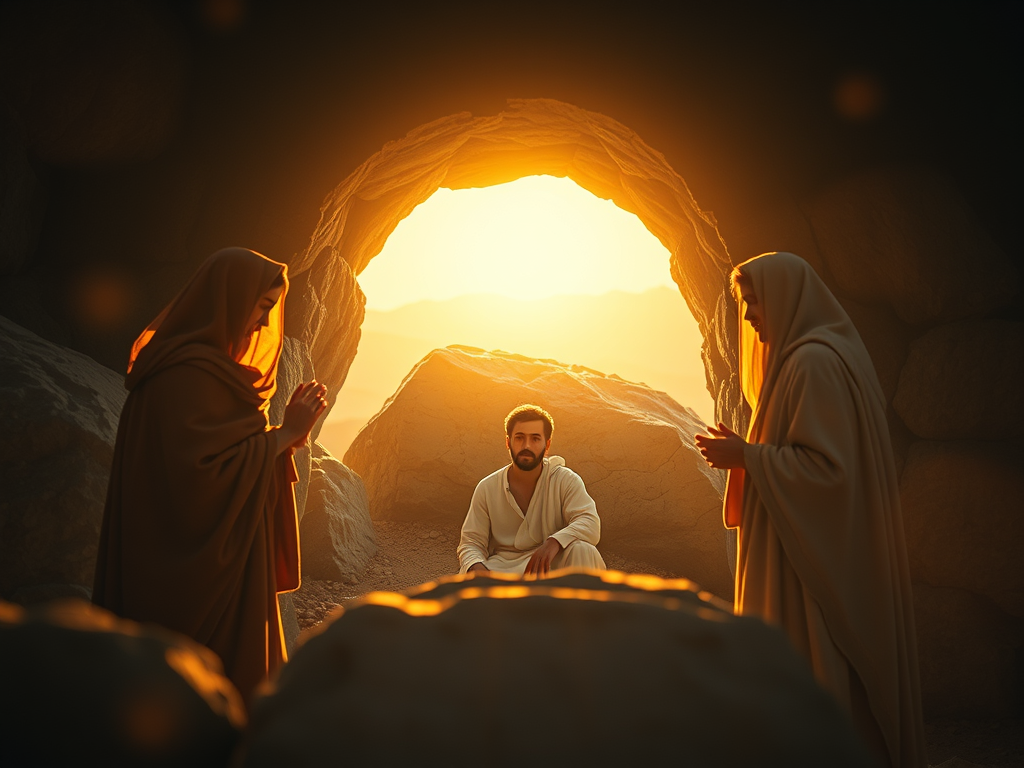
On entering the tomb they saw a young man sitting on the right side, clothed in a white robe, and they were utterly amazed.

6

He said to them, “Do not be amazed! You seek Jesus of Nazareth, the crucified. He has been raised; he is not here. Behold the place where they laid him.

7

But go and tell his disciples and Peter, ‘He is going before you to Galilee; there you will see him, as he told you.'”

8

Then they went out and fled from the tomb, seized with trembling and bewilderment. They said nothing to anyone, for they were afraid.

9

2 When he had risen, early on the first day of the week, he appeared first to Mary Magdalene, out of whom he had driven seven demons.

10

She went and told his companions who were mourning and weeping.

11

When they heard that he was alive and had been seen by her, they did not believe.

12

After this he appeared in another form to two of them walking along on their way to the country.

13

They returned and told the others; but they did not believe them either.

14

(But) later, as the eleven were at table, he appeared to them and rebuked them for their unbelief and hardness of heart because they had not believed those who saw him after he had been raised.

15

He said to them, “Go into the whole world and proclaim the gospel to every creature.

16

Whoever believes and is baptized will be saved; whoever does not believe will be condemned.

17

These signs will accompany those who believe: in my name they will drive out demons, they will speak new languages.

18

They will pick up serpents (with their hands), and if they drink any deadly thing, it will not harm them. They will lay hands on the sick, and they will recover.”

19

So then the Lord Jesus, after he spoke to them, was taken up into heaven and took his seat at the right hand of God.

20

But they went forth and preached everywhere, while the Lord worked with them and confirmed the word through accompanying signs.) 3


1 [1-8] The purpose of this narrative is to show that the tomb is empty and that Jesus has been raised (⇒ Mark 16:6) and is going before you to Galilee (⇒ Mark 16:7) in fulfillment of ⇒ Mark 14:28. The women find the tomb empty, and an angel stationed there announces to them what has happened. They are told to proclaim the news to Peter and the disciples in order to prepare them for a reunion with him. Mark’s composition of the gospel ends at ⇒ Mark 16:8 with the women telling no one, because they were afraid. This abrupt termination causes some to believe that the original ending of this gospel may have been lost. See the following note.
2 [9-20] This passage, termed the Longer Ending to the Marcan gospel by comparison with a much briefer conclusion found in some less important manuscripts, has traditionally been accepted as a canonical part of the gospel and was defined as such by the Council of Trent. Early citations of it by the Fathers indicate that it was composed by the second century, although vocabulary and style indicate that it was written by someone other than Mark. It is a general resume of the material concerning the appearances of the risen Jesus, reflecting, in particular, traditions found in Luke 24 and John 20. The Shorter Ending: Found after ⇒ Mark 16:8 before the Longer Ending in four seventh-to-ninth-century Greek manuscripts as well as in one Old Latin version, where it appears alone without the Longer Ending. The Freer Logion: Found after v 14 in a fourth-fifth century manuscript preserved in the Freer Gallery of Art, Washington, DC, this ending was known to Jerome in the fourth century. It reads: “And they excused themselves, saying, “This age of lawlessness and unbelief is under Satan, who does not allow the truth and power of God to prevail over the unclean things dominated by the spirits [or, does not allow the unclean things dominated by the spirits to grasp the truth and power of God]. Therefore reveal your righteousness now.’ They spoke to Christ. And Christ responded to them, “The limit of the years of Satan’s power is completed, but other terrible things draw near. And for those who sinned I was handed over to death, that they might return to the truth and no longer sin, in order that they might inherit the spiritual and incorruptible heavenly glory of righteousness. But . . . .’ “
3 [20] THE SHORTER ENDING – [And they reported all the instructions briefly to Peter’s companions. Afterwards Jesus himself, through them, sent forth from east to west the sacred and imperishable proclamation of eternal salvation. Amen.]

The Bible – New Testament

Saint Mark

Sain Mark

Index

1. 2. 3. 4. 5. 6. 7. 8. 9.
10. 11. 12. 13. 14. 15. 16.

The Bible – New Testament

Saint Mark

Index

1. 2. 3. 4. 5. 6. 7. 8. 9.
10. 11. 12. 13. 14. 15. 16.

Chapter 7

1

1 Now when the Pharisees with some scribes who had come from Jerusalem gathered around him,

2

they observed that some of his disciples ate their meals with unclean, that is, unwashed, hands.

3

(For the Pharisees and, in fact, all Jews, do not eat without carefully washing their hands, 2 keeping the tradition of the elders.

4

And on coming from the marketplace they do not eat without purifying themselves. And there are many other things that they have traditionally observed, the purification of cups and jugs and kettles (and beds).)

5

So the Pharisees and scribes questioned him, “Why do your disciples not follow the tradition of the elders 3 but instead eat a meal with unclean hands?”

6

He responded, “Well did Isaiah prophesy about you hypocrites, as it is written: ‘This people honors me with their lips, but their hearts are far from me;

7

In vain do they worship me, teaching as doctrines human precepts.’

8

You disregard God’s commandment but cling to human tradition.”

9

He went on to say, “How well you have set aside the commandment of God in order to uphold your tradition!

10

For Moses said, ‘Honor your father and your mother,’ and ‘Whoever curses father or mother shall die.’

11

Yet you say, ‘If a person says to father or mother, “Any support you might have had from me is qorban”‘ 4 (meaning, dedicated to God),

12

you allow him to do nothing more for his father or mother.

13

You nullify the word of God in favor of your tradition that you have handed on. And you do many such things.”

14

He summoned the crowd again and said to them, “Hear me, all of you, and understand.

15

Nothing that enters one from outside can defile that person; but the things that come out from within are what defile.”

16

5

17

6 When he got home away from the crowd his disciples questioned him about the parable.

18

He said to them, “Are even you likewise without understanding? Do you not realize that everything that goes into a person from outside cannot defile,

19

7 since it enters not the heart but the stomach and passes out into the latrine?” (Thus he declared all foods clean.)

20

“But what comes out of a person, that is what defiles.

21

From within people, from their hearts, come evil thoughts, unchastity, theft, murder,

22

adultery, greed, malice, deceit, licentiousness, envy, blasphemy, arrogance, folly.

23

All these evils come from within and they defile.”

24

From that place he went off to the district of Tyre. 8 He entered a house and wanted no one to know about it, but he could not escape notice.

25

Soon a woman whose daughter had an unclean spirit heard about him. She came and fell at his feet.

26

The woman was a Greek, a Syrophoenician by birth, and she begged him to drive the demon out of her daughter.

27

He said to her, “Let the children be fed first. 9 For it is not right to take the food of the children and throw it to the dogs.”

28

She replied and said to him, “Lord, even the dogs under the table eat the children’s scraps.”

29

Then he said to her, “For saying this, you may go. The demon has gone out of your daughter.”

30

When the woman went home, she found the child lying in bed and the demon gone.

31

Again he left the district of Tyre and went by way of Sidon to the Sea of Galilee, into the district of the Decapolis.

32

And people brought to him a deaf man who had a speech impediment and begged him to lay his hand on him.

33

He took him off by himself away from the crowd. He put his finger into the man’s ears and, spitting, touched his tongue;

34

then he looked up to heaven and groaned, and said to him, “Ephphatha!” (that is, “Be opened!”)

35

And (immediately) the man’s ears were opened, his speech impediment was removed, and he spoke plainly.

36

10 He ordered them not to tell anyone. But the more he ordered them not to, the more they proclaimed it.

37

They were exceedingly astonished and they said, “He has done all things well. He makes the deaf hear and (the) mute speak.”


1 [1-23] See the note on ⇒ Matthew 15:1-20. Against the Pharisees’ narrow, legalistic, and external practices of piety in matters of purification (⇒ Mark 7:2-5), external worship (⇒ Mark 7:6-7), and observance of commandments, Jesus sets in opposition the true moral intent of the divine law (⇒ Mark 7:8-13). But he goes beyond contrasting the law and Pharisaic interpretation of it. The parable of ⇒ Mark 7:14-15 in effect sets aside the law itself in respect to clean and unclean food. He thereby opens the way for unity between Jew and Gentile in the kingdom of God, intimated by Jesus’ departure for pagan territory beyond Galilee. For similar contrast see ⇒ Mark 2:1-⇒ 3:6; ⇒ 3:20-35; ⇒ 6:1-6.
2 [3] Carefully washing their hands: refers to ritual purification.
3 [5] Tradition of the elders: the body of detailed, unwritten, human laws regarded by the scribes and Pharisees to have the same binding force as that of the Mosaic law; cf ⇒ Gal 1:14.
4 [11] Qorban: a formula for a gift to God, dedicating the offering to the temple, so that the giver might continue to use it for himself but not give it to others, even needy parents.
5 [16] ⇒ Mark 7:16, “Anyone who has ears to hear ought to hear,” is omitted because it is lacking in some of the best Greek manuscripts and was probably transferred here by scribes from ⇒ Mark 4:9, ⇒ 23.
6 [17] Away from the crowd . . . the parable: in this context of privacy the term parable refers to something hidden, about to be revealed to the disciples; cf ⇒ Mark 4:10-11.34. Jesus sets the Mosaic food laws in the context of the kingdom of God where they are abrogated, and he declares moral defilement the only cause of uncleanness.
7 [19] (Thus he declared all foods clean): if this bold declaration goes back to Jesus, its force was not realized among Jewish Christians in the early church; cf ⇒ Acts 10:1-⇒ 11:18.
8 [24-37] The withdrawal of Jesus to the district of Tyre may have been for a respite (⇒ Mark 7:24), but he soon moved onward to Sidon and, by way of the Sea of Galilee, to the Decapolis. These districts provided a Gentile setting for the extension of his ministry of healing because the people there acknowledged his power (⇒ Mark 7:29, ⇒ 37). The actions attributed to Jesus (⇒ Mark 7:33-35) were also used by healers of the time.
9 [27-28] The figure of a household in which children at table are fed first and then their leftover food is given to the dogs under the table is used effectively to acknowledge the prior claim of the Jews to the ministry of Jesus; however, Jesus accedes to the Gentile woman’s plea for the cure of her afflicted daughter because of her faith.
10 [36] The more they proclaimed it: the same verb proclaim attributed here to the crowd in relation to the miracles of Jesus is elsewhere used in Mark for the preaching of the gospel on the part of Jesus, of his disciples, and of the Christian community (⇒ Mark 1:14; ⇒ 13:10; ⇒ 14:9). Implied in the action of the crowd is a recognition of the salvific mission of Jesus; see the note on ⇒ Matthew 11:5-6.

The Bible – New Testament

Saint Mark

Index

1. 2. 3. 4. 5. 6. 7. 8. 9.
10. 11. 12. 13. 14. 15. 16.

The Bible – New Testament

Saint Mark

Index

1. 2. 3. 4. 5. 6. 7. 8. 9.
10. 11. 12. 13. 14. 15. 16.

Chapter 6

1

He departed from there and came to his native place, 1 accompanied by his disciples.

2

2 When the sabbath came he began to teach in the synagogue, and many who heard him were astonished. They said, “Where did this man get all this? What kind of wisdom has been given him? What mighty deeds are wrought by his hands!

3

Is he not the carpenter, 3 the son of Mary, and the brother of James and Joses and Judas and Simon? And are not his sisters here with us?” And they took offense at him.

4

4 Jesus said to them, “A prophet is not without honor except in his native place and among his own kin and in his own house.”

5

So he was not able to perform any mighty deed there, 5 apart from curing a few sick people by laying his hands on them.

6

He was amazed at their lack of faith. He went around to the villages in the vicinity teaching.

7

He summoned the Twelve 6 and began to send them out two by two and gave them authority over unclean spirits.

8

7 He instructed them to take nothing for the journey but a walking stick – no food, no sack, no money in their belts.

9

They were, however, to wear sandals but not a second tunic.

10

8 He said to them, “Wherever you enter a house, stay there until you leave from there.

11

Whatever place does not welcome you or listen to you, leave there and shake the dust off your feet in testimony against them.”

12

So they went off and preached repentance.

13

9 They drove out many demons, and they anointed with oil many who were sick and cured them.

14

10 King Herod 11 heard about it, for his fame had become widespread, and people were saying, “John the Baptist has been raised from the dead; that is why mighty powers are at work in him.”

15

Others were saying, “He is Elijah”; still others, “He is a prophet like any of the prophets.”

16

But when Herod learned of it, he said, “It is John whom I beheaded. He has been raised up.”

17

12 Herod was the one who had John arrested and bound in prison on account of Herodias, the wife of his brother Philip, whom he had married.

18

John had said to Herod, “It is not lawful for you to have your brother’s wife.”

19

Herodias 13 harbored a grudge against him and wanted to kill him but was unable to do so.

20

Herod feared John, knowing him to be a righteous and holy man, and kept him in custody. When he heard him speak he was very much perplexed, yet he liked to listen to him.

21

She had an opportunity one day when Herod, on his birthday, gave a banquet for his courtiers, his military officers, and the leading men of Galilee.

22

Herodias’s own daughter came in and performed a dance that delighted Herod and his guests. The king said to the girl, “Ask of me whatever you wish and I will grant it to you.”

23

He even swore (many things) to her, “I will grant you whatever you ask of me, even to half of my kingdom.”

24

She went out and said to her mother, “What shall I ask for?” She replied, “The head of John the Baptist.”

25

The girl hurried back to the king’s presence and made her request, “I want you to give me at once on a platter the head of John the Baptist.”

26

The king was deeply distressed, but because of his oaths and the guests he did not wish to break his word to her.

27

So he promptly dispatched an executioner with orders to bring back his head. He went off and beheaded him in the prison.

28

He brought in the head on a platter and gave it to the girl. The girl in turn gave it to her mother.

29

When his disciples heard about it, they came and took his body and laid it in a tomb.

30

The apostles 14 gathered together with Jesus and reported all they had done and taught.

31

15 He said to them, “Come away by yourselves to a deserted place and rest a while.” People were coming and going in great numbers, and they had no opportunity even to eat.

32

So they went off in the boat by themselves to a deserted place.

33

People saw them leaving and many came to know about it. They hastened there on foot from all the towns and arrived at the place before them.

34

When he disembarked and saw the vast crowd, his heart was moved with pity for them, for they were like sheep without a shepherd; and he began to teach them many things.

35

16 By now it was already late and his disciples approached him and said, “This is a deserted place and it is already very late.

36

Dismiss them so that they can go to the surrounding farms and villages and buy themselves something to eat.”

37

He said to them in reply, “Give them some food yourselves.” But they said to him, “Are we to buy two hundred days’ wages worth of food and give it to them to eat?”

38

He asked them, “How many loaves do you have? Go and see.” And when they had found out they said, “Five loaves and two fish.”

39

So he gave orders to have them sit down in groups on the green grass.

40

17 The people took their places in rows by hundreds and by fifties.

41

Then, taking the five loaves and the two fish and looking up to heaven, he said the blessing, broke the loaves, and gave them to (his) disciples to set before the people; he also divided the two fish among them all. 18

42

They all ate and were satisfied.

43

And they picked up twelve wicker baskets full of fragments and what was left of the fish.

44

Those who ate (of the loaves) were five thousand men.

45

19 Then he made his disciples get into the boat and precede him to the other side toward Bethsaida, 20 while he dismissed the crowd.

46

21 And when he had taken leave of them, he went off to the mountain to pray.

47

When it was evening, the boat was far out on the sea and he was alone on shore.

48

Then he saw that they were tossed about while rowing, for the wind was against them. About the fourth watch of the night, he came toward them walking on the sea. 22 He meant to pass by them.

49

But when they saw him walking on the sea, they thought it was a ghost and cried out.

50

23 They had all seen him and were terrified. But at once he spoke with them, “Take courage, it is I, do not be afraid!”

51

He got into the boat with them and the wind died down. They were (completely) astounded.

52

They had not understood the incident of the loaves. 24 On the contrary, their hearts were hardened.

53

After making the crossing, they came to land at Gennesaret and tied up there.

54

As they were leaving the boat, people immediately recognized him.

55

They scurried about the surrounding country and began to bring in the sick on mats to wherever they heard he was.

56

Whatever villages or towns or countryside he entered, they laid the sick in the marketplaces and begged him that they might touch only the tassel on his cloak; and as many as touched it were healed.

 
1 [1] His native place: the Greek word patris here refers to Nazareth (cf ⇒ Mark 1:9; ⇒ Luke 4:16, ⇒ 23-24) though it can also mean native land.
2 [2-6] See the note on ⇒ Matthew 13:54-58.
3 [3] Is he not the carpenter?: no other gospel calls Jesus a carpenter. Some witnesses have “the carpenter’s son,” as in ⇒ Matthew 13:55. Son of Mary: contrary to Jewish custom, which calls a man the son of his father, this expression may reflect Mark’s own faith that God is the Father of Jesus (⇒ Mark 1:1, ⇒ 11; ⇒ 8:38; ⇒ 13:32; ⇒ 14:36). The brother of James . . . Simon: in Semitic usage, the terms “brother,” “sister” are applied not only to children of the same parents, but to nephews, nieces, cousins, half-brothers, and half-sisters; cf ⇒ Genesis 14:16; ⇒ 29:15; ⇒ Lev 10:4. While one cannot suppose that the meaning of a Greek word should be sought in the first place from Semitic usage, the Septuagint often translates the Hebrew ah by the Greek word adelphos, “brother,” as in the cited passages, a fact that may argue for a similar breadth of meaning in some New Testament passages. For instance, there is no doubt that in v 17, “brother” is used of Philip, who was actually the half-brother of Herod Antipas. On the other hand, Mark may have understood the terms literally; see also ⇒ Mark 3:31-32; ⇒ Matthew 12:46; ⇒ 13:55-56; ⇒ Luke 8:19; ⇒ John 7:3, 5. The question of meaning here would not have arisen but for the faith of the church in Mary’s perpetual virginity.
4 [4] A prophet is not without honor except . . . in his own house: a saying that finds parallels in other literatures, especially Jewish and Greek, but without reference to a prophet. Comparing himself to previous Hebrew prophets whom the people rejected, Jesus intimates his own eventual rejection by the nation especially in view of the dishonor his own relatives had shown him (⇒ Mark 3:21) and now his townspeople as well.
5 [5] He was not able to perform any mighty deed there: according to Mark, Jesus’ power could not take effect because of a person’s lack of faith.
6 [7-13] The preparation for the mission of the Twelve is seen in the call (1) of the first disciples to be fishers of men (⇒ Mark 1:16-20), (2) then of the Twelve set apart to be with Jesus and to receive authority to preach and expel demons (⇒ Mark 3:13-19). Now they are given the specific mission to exercise that authority in word and power as representatives of Jesus during the time of their formation.
7 [8-9] In Mark the use of a walking stick (⇒ Mark 6:8) and sandals (⇒ Mark 6:9) is permitted, but not in ⇒ Matthew 10:10 nor in ⇒ Luke 10:4. Mark does not mention any prohibition to visit pagan territory and to enter Samaritan towns. These differences indicate a certain adaptation to conditions in and outside of Palestine and suggest in Mark’s account a later activity in the church. For the rest, Jesus required of his apostles a total dependence on God for food and shelter; cf ⇒ Mark 6:35-44; ⇒ 8:1-9.
8 [10-11] Remaining in the same house as a guest (⇒ Mark 6:10) rather than moving to another offering greater comfort avoided any impression of seeking advantage for oneself and prevented dishonor to one’s host. Shaking the dust off one’s feet served as testimony against those who rejected the call to repentance.
9 [13] Anointed with oil . . . cured them: a common medicinal remedy, but seen here as a vehicle of divine power for healing.
10 [14-16] The various opinions about Jesus anticipate the theme of his identity that reaches its climax in ⇒ Mark 8:27-30.
11 [14] King Herod: see the note on ⇒ Matthew 14:1.
12 [17-29] Similarities are to be noted between Mark’s account of the imprisonment and death of John the Baptist in this pericope, and that of the passion of Jesus (⇒ Mark 15:1-47). Herod and Pilate, each in turn, acknowledges the holiness of life of one over whom he unjustly exercises the power of condemnation and death (⇒ Mark 6:26-27; ⇒ 15:9-10, ⇒ 14-15). The hatred of Herodias toward John parallels that of the Jewish leaders toward Jesus. After the deaths of John and of Jesus, well-disposed persons request the bodies of the victims of Herod and of Pilate in turn to give them respectful burial (⇒ Mark 6:29; ⇒ 15:45-46).
13 [19] Herodias: see the note on ⇒ Matthew 14:3.
14 [30] Apostles: here, and in some manuscripts at ⇒ Mark 3:14, Mark calls apostles (i.e., those sent forth) the Twelve whom Jesus sends as his emissaries, empowering them to preach, to expel demons, and to cure the sick (⇒ Mark 6:13). Only after Pentecost is the title used in the technical sense.
15 [31-34] The withdrawal of Jesus with his disciples to a desert place to rest attracts a great number of people to follow them. Toward this people of the new exodus Jesus is moved with pity; he satisfies their spiritual hunger by teaching them many things, thus gradually showing himself the faithful shepherd of a new Israel; cf ⇒ Numbers 27:17; ⇒ Ezekiel 34:15.
16 [35] See the note on ⇒ Matthew 14:13-21. Compare this section with ⇒ Mark 8:1-9. The various accounts of the multiplication of loaves and fishes, two each in Mark and in Matthew and one each in Luke and in John, indicate the wide interest of the early church in their eucharistic gatherings; see, e.g., ⇒ Mark 6:41; ⇒ 8:6; ⇒ 14:22; and recall also the sign of bread in Exodus 16; ⇒ Deut 8:3-16; ⇒ Psalm 78:24-25; ⇒ 105:40; ⇒ Wisdom 16:20-21.
17 [40] The people . . . in rows by hundreds and by fifties: reminiscent of the groupings of Israelites encamped in the desert (⇒ Exodus 18:21-25) and of the wilderness tradition of the prophets depicting the transformation of the wasteland into pastures where the true shepherd feeds his flock (⇒ Ezekiel 34:25-26) and makes his people beneficiaries of messianic grace.
18 [41] On the language of this verse as eucharistic (cf ⇒ Mark 14:22), see the notes on ⇒ Matthew 14:19, ⇒ 20. Jesus observed the Jewish table ritual of blessing God before partaking of food.
19 [45-52] See the note on ⇒ Matthew 14:22-33.
20 [45] To the other side toward Bethsaida: a village at the northeastern shore of the Sea of Galilee.
21 [46] He went off to the mountain to pray: see ⇒ Mark 1:35-38. In ⇒ John 6:15 Jesus withdrew to evade any involvement in the false messianic hopes of the multitude.
22 [48] Walking on the sea: see the notes on ⇒ Matthew 14:22-33 and on ⇒ John 6:19.
23 [50] It is I, do not be afraid!: literally, “I am.” This may reflect the divine revelatory formula of ⇒ Exodus 3:14; ⇒ Isaiah 41:4, ⇒ 10, ⇒ 14; ⇒ 43:1-3, ⇒ 10, ⇒ 13. Mark implies the hidden identity of Jesus as Son of God.
24 [52] They had not understood . . . the loaves: the revelatory character of this sign and that of the walking on the sea completely escaped the disciples. Their hearts were hardened: in ⇒ Mark 3:5-6 hardness of heart was attributed to those who did not accept Jesus and plotted his death. Here the same disposition prevents the disciples from comprehending Jesus’ self-revelation through signs; cf ⇒ Mark 8:17.

Index

1. 2. 3. 4. 5. 6. 7. 8. 9.

10. 11. 12. 13. 14. 15. 16.

Saint Mark – Chapter 2

The Bible – New Testament Saint Mark Index 1. 2. 3. 4. 5. 6. 7. 8. 9. 10. 11. 12. 13. 14. 15. 16. Chapter 2 1 1 2 When Jesus returned to Capernaum after some days, it became known that he was at home. 2 Many gathered together so that there was no longer room for them, not… Continue reading Saint Mark – Chapter 2

Published
Categorised as SAINT MARK

The Bible – New Testament

Saint Mark

Index

1. 2. 3. 4. 5. 6. 7. 8. 9.
10. 11. 12. 13. 14. 15. 16.

Sain Mark

Chapter 1

1

1 2 The beginning of the gospel of Jesus Christ (the Son of God).

2

As it is written in Isaiah the prophet: 3 “Behold, I am sending my messenger ahead of you; he will prepare your way.

3

A voice of one crying out in the desert: ‘Prepare the way of the Lord, make straight his paths.'”

4

John (the) Baptist appeared in the desert proclaiming a baptism of repentance for the forgiveness of sins.

5

People of the whole Judean countryside and all the inhabitants of Jerusalem were going out to him and were being baptized by him in the Jordan River as they acknowledged their sins.

6

John was clothed in camel’s hair, with a leather belt around his waist. 4 He fed on locusts and wild honey.

7

And this is what he proclaimed: “One mightier than I is coming after me. I am not worthy to stoop and loosen the thongs of his sandals.

8

5 I have baptized you with water; he will baptize you with the holy Spirit.”

9

It happened in those days that Jesus came from Nazareth of Galilee and was baptized in the Jordan by John.

10

On coming up out of the water he saw the heavens being torn open and the Spirit, like a dove, descending upon him. 6

11

And a voice came from the heavens, “You are my beloved Son; with you I am well pleased.”

12

7 At once the Spirit drove him out into the desert,

13

and he remained in the desert for forty days, tempted by Satan. He was among wild beasts, and the angels ministered to him.

14

After John had been arrested, 8 Jesus came to Galilee proclaiming the gospel of God:

15

“This is the time of fulfillment. The kingdom of God is at hand. Repent, and believe in the gospel.”

16

9 As he passed by the Sea of Galilee, he saw Simon and his brother Andrew casting their nets into the sea; they were fishermen.

17

Jesus said to them, “Come after me, and I will make you fishers of men.”

18

Then they abandoned their nets and followed him.

19

He walked along a little farther and saw James, the son of Zebedee, and his brother John. They too were in a boat mending their nets.

20

Then he called them. So they left their father Zebedee in the boat along with the hired men and followed him.

21

10 Then they came to Capernaum, and on the sabbath he entered the synagogue and taught.

22

The people were astonished at his teaching, for he taught them as one having authority and not as the scribes.

23

11 In their synagogue was a man with an unclean spirit;

24

12 he cried out, “What have you to do with us, 13 Jesus of Nazareth? Have you come to destroy us? I know who you are – the Holy One of God!”

25

Jesus rebuked him and said, “Quiet! Come out of him!”

26

The unclean spirit convulsed him and with a loud cry came out of him.

27

All were amazed and asked one another, “What is this? A new teaching with authority. He commands even the unclean spirits and they obey him.”

28

His fame spread everywhere throughout the whole region of Galilee.

29

On leaving the synagogue he entered the house of Simon and Andrew with James and John.

30

Simon’s mother-in-law lay sick with a fever. They immediately told him about her.

31

He approached, grasped her hand, and helped her up. Then the fever left her and she waited on them.

32

When it was evening, after sunset, they brought to him all who were ill or possessed by demons.

33

The whole town was gathered at the door.

34

He cured many who were sick with various diseases, and he drove out many demons, not permitting them to speak because they knew him.

35

Rising very early before dawn, he left and went off to a deserted place, where he prayed.

36

Simon and those who were with him pursued him

37

and on finding him said, “Everyone is looking for you.”

38

He told them, “Let us go on to the nearby villages that I may preach there also. For this purpose have I come.”

39

So he went into their synagogues, preaching and driving out demons throughout the whole of Galilee.

40

A leper 14 came to him (and kneeling down) begged him and said, “If you wish, you can make me clean.”

41

Moved with pity, he stretched out his hand, touched him, and said to him, “I do will it. Be made clean.”

42

The leprosy left him immediately, and he was made clean.

43

Then, warning him sternly, he dismissed him at once.

44

Then he said to him, “See that you tell no one anything, but go, show yourself to the priest and offer for your cleansing what Moses prescribed; that will be proof for them.”

45

The man went away and began to publicize the whole matter. He spread the report abroad so that it was impossible for Jesus to enter a town openly. He remained outside in deserted places, and people kept coming to him from everywhere.

 
1 [1-13] The prologue of the Gospel according to Mark begins with the title (⇒ Mark 1:1) followed by three events preparatory to Jesus’ preaching: (1) the appearance in the Judean wilderness of John, baptizer, preacher of repentance, and precursor of Jesus (⇒ Mark 1:2-8); (2) the baptism of Jesus, at which a voice from heaven acknowledges Jesus to be God’s Son, and the holy Spirit descends on him (⇒ Mark 1:9-11); (3) the temptation of Jesus by Satan (⇒ Mark 1:12-13).
2 [1] The gospel of Jesus Christ [the Son of God]: the “good news” of salvation in and through Jesus, crucified and risen, acknowledged by the Christian community as Messiah (⇒ Mark 8:29; ⇒ 14:61-62) and Son of God (⇒ Mark 1:11; ⇒ 9:7; ⇒ 15:39), although some important manuscripts here omit the Son of God.
3 [2-3] Although Mark attributes the prophecy to Isaiah, the text is a combination of ⇒ Malachi 3:1; ⇒ Isaiah 40:3; ⇒ Exodus 23:20; cf ⇒ Matthew 11:10; ⇒ Luke 7:27. John’s ministry is seen as God’s prelude to the saving mission of his Son. The way of the Lord: this prophecy of Deutero-Isaiah concerning the end of the Babylonian exile is here applied to the coming of Jesus; John the Baptist is to prepare the way for him.
4 [6] Clothed in camel’s hair . . . waist: the Baptist’s garb recalls that of Elijah in ⇒ 2 Kings 1:8. Jesus speaks of the Baptist as Elijah who has already come (⇒ Mark 9:11-13; ⇒ Matthew 17:10-12; cf ⇒ Malachi 3:23-24; ⇒ Luke 1:17).
5 [8-9] Through the life-giving baptism with the holy Spirit (⇒ Mark 1:8), Jesus will create a new people of God. But first he identifies himself with the people of Israel in submitting to John’s baptism of repentance and in bearing on their behalf the burden of God’s decisive judgment (⇒ Mark 1:9; cf ⇒ Mark 1:4). As in the desert of Sinai, so here in the wilderness of Judea, Israel’s sonship with God is to be renewed.
6 [10-11] He saw the heavens . . . and the Spirit . . . upon him: indicating divine intervention in fulfillment of promise. Here the descent of the Spirit on Jesus is meant, anointing him for his ministry; cf ⇒ Isaiah 11:2; ⇒ 42:1; ⇒ 61:1; ⇒ 63:9. A voice . . . with you I am well pleased: God’s acknowledgment of Jesus as his unique Son, the object of his love. His approval of Jesus is the assurance that Jesus will fulfill his messianic mission of salvation.
7 [12-13] The same Spirit who descended on Jesus in his baptism now drives him into the desert for forty days. The result is radical confrontation and temptation by Satan who attempts to frustrate the work of God. The presence of wild beasts may indicate the horror and danger of the desert regarded as the abode of demons or may reflect the paradise motif of harmony among all creatures; cf ⇒ Isaiah 11:6-9. The presence of ministering angels to sustain Jesus recalls the angel who guided the Israelites in the desert in the first Exodus (⇒ Exodus 14:19; ⇒ 23:20) and the angel who supplied nourishment to Elijah in the wilderness (⇒ 1 Kings 19:5-7). The combined forces of good and evil were present to Jesus in the desert. His sustained obedience brings forth the new Israel of God there where Israel’s rebellion had brought death and alienation.
8 [14-15] After John had been arrested: in the plan of God, Jesus was not to proclaim the good news of salvation prior to the termination of the Baptist’s active mission. Galilee: in the Marcan account, scene of the major part of Jesus’ public ministry before his arrest and condemnation. The gospel of God: not only the good news from God but about God at work in Jesus Christ. This is the time of fulfillment: i.e., of God’s promises. The kingdom of God . . . repent: see the note on ⇒ Matthew 3:2.
9 [16-20] These verses narrate the call of the first Disciples. See the notes on ⇒ Matthew 4:18-22 and ⇒ Matthew 4:20.
10 [21-45] The account of a single day’s ministry of Jesus on a sabbath in and outside the synagogue of Capernaum (⇒ Mark 1:21-31) combines teaching and miracles of exorcism and healing. Mention is not made of the content of the teaching but of the effect of astonishment and alarm on the people. Jesus’ teaching with authority, making an absolute claim on the hearer, was in the best tradition of the ancient prophets, not of the scribes. The narrative continues with events that evening (⇒ Mark 1:32-34; see the notes on ⇒ Matthew 8:14-17) and the next day (⇒ Mark 1:35-39). The cleansing in ⇒ Mark 1:40-45 stands as an isolated story.
11 [23] An unclean spirit: so called because of the spirit’s resistance to the holiness of God. The spirit knows and fears the power of Jesus to destroy his influence; cf ⇒ Mark 1:32, ⇒ 34; ⇒ 3:11; ⇒ 6:13.
12 [24-25] The Holy One of God: not a confession but an attempt to ward off Jesus’ power, reflecting the notion that use of the precise name of an opposing spirit would guarantee mastery over him. Jesus silenced the cry of the unclean spirit and drove him out of the man.
13 [24] What have you to do with us?: see the note on ⇒ John 2:4.
14 [40] A leper: for the various forms of skin disease, see ⇒ Lev 13:1-50 and the note on ⇒ Lev 13:2-4. There are only two instances in the Old Testament in which God is shown to have cured a leper (⇒ Numbers 12:10-15; ⇒ 2 Kings 5:1-14). The law of Moses provided for the ritual purification of a leper. In curing the leper, Jesus assumes that the priests will reinstate the cured man into the religious community. See also the note on ⇒ Luke 5:14.

The Bible – New Testament

Saint Mark

Index

1. 2. 3. 4. 5. 6. 7. 8. 9.
10. 11. 12. 13. 14. 15. 16.

Sain Mark

The Bible – New Testament

Saint Mark

Index

1. 2. 3. 4. 5. 6. 7. 8. 9.
10. 11. 12. 13. 14. 15. 16.

Sain Mark

Chapter 9

1

1 He also said to them, “Amen, I say to you, there are some standing here who will not taste death until they see that the kingdom of God has come in power.”

2

2 After six days Jesus took Peter, James, and John and led them up a high mountain apart by themselves. And he was transfigured before them,

3

and his clothes became dazzling white, such as no fuller on earth could bleach them.

4

Then Elijah appeared to them along with Moses, and they were conversing with Jesus.

5

3 Then Peter said to Jesus in reply, “Rabbi, it is good that we are here! Let us make three tents: one for you, one for Moses, and one for Elijah.”

6

He hardly knew what to say, they were so terrified.

7

Then a cloud came, casting a shadow over them; 4 then from the cloud came a voice, “This is my beloved Son. Listen to him.”

8

Suddenly, looking around, they no longer saw anyone but Jesus alone with them.

9

5 As they were coming down from the mountain, he charged them not to relate what they had seen to anyone, except when the Son of Man had risen from the dead.

10

So they kept the matter to themselves, questioning what rising from the dead meant.

11

Then they asked him, “Why do the scribes say that Elijah must come first?”

12

He told them, “Elijah will indeed come first and restore all things, yet how is it written regarding the Son of Man that he must suffer greatly and be treated with contempt?

13

But I tell you that Elijah has come and they did to him whatever they pleased, as it is written of him.”

14

6 When they came to the disciples, they saw a large crowd around them and scribes arguing with them.

15

Immediately on seeing him, the whole crowd was utterly amazed. They ran up to him and greeted him.

16

He asked them, “What are you arguing about with them?”

17

Someone from the crowd answered him, “Teacher, I have brought to you my son possessed by a mute spirit.

18

Wherever it seizes him, it throws him down; he foams at the mouth, grinds his teeth, and becomes rigid. I asked your disciples to drive it out, but they were unable to do so.”

19

He said to them in reply, “O faithless generation, how long will I be with you? How long will I endure you? Bring him to me.”

20

They brought the boy to him. And when he saw him, the spirit immediately threw the boy into convulsions. As he fell to the ground, he began to roll around and foam at the mouth.

21

Then he questioned his father, “How long has this been happening to him?” He replied, “Since childhood.

22

It has often thrown him into fire and into water to kill him. But if you can do anything, have compassion on us and help us.”

23

Jesus said to him, ” ‘If you can!’ Everything is possible to one who has faith.”

24

Then the boy’s father cried out, “I do believe, help my unbelief!”

25

Jesus, on seeing a crowd rapidly gathering, rebuked the unclean spirit and said to it, “Mute and deaf spirit, I command you: come out of him and never enter him again!”

26

Shouting and throwing the boy into convulsions, it came out. He became like a corpse, which caused many to say, “He is dead!”

27

But Jesus took him by the hand, raised him, and he stood up.

28

When he entered the house, his disciples asked him in private, “Why could we not drive it out?”

29

7 He said to them, “This kind can only come out through prayer.”

30

They left from there and began a journey through Galilee, but he did not wish anyone to know about it.

31

He was teaching his disciples and telling them, “The Son of Man is to be handed over to men and they will kill him, and three days after his death he will rise.”

32

But they did not understand the saying, and they were afraid to question him.

33

8 They came to Capernaum and, once inside the house, he began to ask them, “What were you arguing about on the way?”

34

But they remained silent. They had been discussing among themselves on the way who was the greatest.

35

Then he sat down, called the Twelve, and said to them, “If anyone wishes to be first, he shall be the last of all and the servant of all.”

36

Taking a child he placed it in their midst, and putting his arms around it he said to them,

37

“Whoever receives one child such as this in my name, receives me; and whoever receives me, receives not me but the one who sent me.”

38

9 John said to him, “Teacher, we saw someone driving out demons in your name, and we tried to prevent him because he does not follow us.”

39

Jesus replied, “Do not prevent him. There is no one who performs a mighty deed in my name who can at the same time speak ill of me.

40

For whoever is not against us is for us.

41

Anyone who gives you a cup of water to drink because you belong to Christ, amen, I say to you, will surely not lose his reward.

42

“Whoever causes one of these little ones who believe (in me) to sin, it would be better for him if a great millstone were put around his neck and he were thrown into the sea.

43

If your hand causes you to sin, cut it off. It is better for you to enter into life maimed than with two hands to go into Gehenna, 10 into the unquenchable fire.

44

11

45

And if your foot causes you to sin, cut it off. It is better for you to enter into life crippled than with two feet to be thrown into Gehenna.

47

And if your eye causes you to sin, pluck it out. Better for you to enter into the kingdom of God with one eye than with two eyes to be thrown into Gehenna,

48

where ‘their worm does not die, and the fire is not quenched.’

49

12 “Everyone will be salted with fire.

50

Salt is good, but if salt becomes insipid, with what will you restore its flavor? Keep salt in yourselves and you will have peace with one another.”

 
1 [1] There are some standing . . . come in power: understood by some to refer to the establishment by God’s power of his kingdom on earth in and through the church; more likely, as understood by others, a reference to the imminent parousia.
2 [2-8] Mark and ⇒ Matthew 17:1 place the transfiguration of Jesus six days after the first prediction of his passion and death and his instruction to the disciples on the doctrine of the cross; ⇒ Luke 9:28 has “about eight days.” Thus the transfiguration counterbalances the prediction of the passion by affording certain of the disciples insight into the divine glory that Jesus possessed. His glory will overcome his death and that of his disciples; cf ⇒ 2 Cor 3:18; ⇒ 2 Peter 1:16-19. The heavenly voice (⇒ Mark 9:7) prepares the disciples to understand that in the divine plan Jesus must die ignominiously before his messianic glory is made manifest; cf ⇒ Luke 24:25-27. See further the note on ⇒ Matthew 17:1-8.
3 [5] Moses and Elijah represent respectively law and prophecy in the Old Testament and are linked to Matthew. Sinai; cf ⇒ Exodus 19:16-⇒ 20:17; ⇒ 1 Kings 19:2, ⇒ 8-14. They now appear with Jesus as witnesses to the fulfillment of the law and the prophets taking place in the person of Jesus as he appears in glory.
4 [7] A cloud came, casting a shadow over them: even the disciples enter into the mystery of his glorification. In the Old Testament the cloud covered the meeting tent, indicating the Lord’s presence in the midst of his people (⇒ Exodus 40:34-35) and came to rest upon the temple in Jerusalem at the time of its dedication (⇒ 1 Kings 8:10).
5 [9-13] At the transfiguration of Jesus his disciples had seen Elijah. They were perplexed because, according to the rabbinical interpretation of ⇒ Malachi 3:23-24, Elijah was to come first. Jesus’ response shows that Elijah has come, in the person of John the Baptist, to prepare for the day of the Lord. Jesus must suffer greatly and be treated with contempt (⇒ Mark 9:12) like the Baptist (⇒ Mark 9:13); cf ⇒ Mark 6:17-29.
6 [14-29] The disciples’ failure to effect a cure seems to reflect unfavorably on Jesus (⇒ Mark 9:14-18, ⇒ 22). In response Jesus exposes their lack of trust in God (⇒ Mark 4:19) and scores their lack of prayer (⇒ Mark 4:29), i.e., of conscious reliance on God’s power when acting in Jesus’ name. For Matthew, see the note on ⇒ Matthew 17:14-20. ⇒ Luke 9:37-43 centers attention on Jesus’ sovereign power.
7 [29] This kind can only come out through prayer: a variant reading adds “and through fasting.”
8 [33-37] Mark probably intends this incident and the sayings that follow as commentary on the disciples’ lack of understanding (⇒ Mark 9:32). Their role in Jesus’ work is one of service, especially to the poor and lowly. Children were the symbol Jesus used for the anawim, the poor in spirit, the lowly in the Christian community.
9 [38-41] Jesus warns against jealousy and intolerance toward others, such as exorcists who do not follow us. The saying in ⇒ Mark 9:40 is a broad principle of the divine tolerance. Even the smallest courtesies shown to those who teach in Jesus’ name do not go unrewarded.
10 [43,45,47] Gehenna: see the note on ⇒ Matthew 5:22.
11 [44,46] These verses, lacking in some important early manuscripts, are here omitted as scribal additions. They simply repeat ⇒ Mark 9:48 itself a modified citation of ⇒ Isaiah 66:24.
12 [49] Everyone will be salted with fire: so the better manuscripts. Some add “every sacrifice will be salted with salt.” The purifying and preservative use of salt in food (⇒ Lev 2:13) and the refinement effected through fire refer here to comparable effects in the spiritual life of the disciples of Jesus.

The Bible – New Testament

Saint Mark

1. 2. 3. 4. 5. 6. 7. 8. 9.

10. 11. 12. 13. 14. 15. 16.

Saint Mark – Chapter 10

The Bible – New Testament Saint Mark Index 1. 2. 3. 4. 5. 6. 7. 8. 9. 10. 11. 12. 13. 14. 15. 16. Chapter 10 1 He set out from there and went into the district of Judea (and) across the Jordan. Again crowds gathered around him and, as was his custom, he again taught them.… Continue reading Saint Mark – Chapter 10

Published
Categorised as SAINT MARK

The Bible – New Testament

Saint Mark

Index

1. 2. 3. 4. 5. 6. 7. 8. 9.
10. 11. 12. 13. 14. 15. 16.

Sain Mark

Chapter 5

1

1 They came to the other side of the sea, to the territory of the Gerasenes.

2

When he got out of the boat, at once a man 2 from the tombs who had an unclean spirit met him.

3

The man had been dwelling among the tombs, and no one could restrain him any longer, even with a chain.

4

In fact, he had frequently been bound with shackles and chains, but the chains had been pulled apart by him and the shackles smashed, and no one was strong enough to subdue him.

5

Night and day among the tombs and on the hillsides he was always crying out and bruising himself with stones.

6

Catching sight of Jesus from a distance, he ran up and prostrated himself before him,

7

crying out in a loud voice, “What have you to do with me, 3 Jesus, Son of the Most High God? I adjure you by God, do not torment me!”

8

(He had been saying to him, “Unclean spirit, come out of the man!”)

9

4 He asked him, “What is your name?” He replied, “Legion is my name. There are many of us.”

10

And he pleaded earnestly with him not to drive them away from that territory.

11

Now a large herd of swine 5 was feeding there on the hillside.

12

And they pleaded with him, “Send us into the swine. Let us enter them.”

13

And he let them, and the unclean spirits came out and entered the swine. The herd of about two thousand rushed down a steep bank into the sea, where they were drowned.

14

The swineherds ran away and reported the incident in the town and throughout the countryside. And people came out to see what had happened.

15

As they approached Jesus, they caught sight of the man who had been possessed by Legion, sitting there clothed and in his right mind. And they were seized with fear.

16

Those who witnessed the incident explained to them what had happened to the possessed man and to the swine.

17

Then they began to beg him to leave their district.

18

As he was getting into the boat, the man who had been possessed pleaded to remain with him.

19

But he would not permit him but told him instead, “Go home 6 to your family and announce to them all that the Lord in his pity has done for you.”

20

Then the man went off and began to proclaim in the Decapolis what Jesus had done for him; and all were amazed.

21

7 When Jesus had crossed again (in the boat) to the other side, a large crowd gathered around him, and he stayed close to the sea.

22

One of the synagogue officials, named Jairus, came forward. Seeing him he fell at his feet

23

and pleaded earnestly with him, saying, “My daughter is at the point of death. Please, come lay your hands on her 8 that she may get well and live.”

24

He went off with him, and a large crowd followed him and pressed upon him.

25

There was a woman afflicted with hemorrhages for twelve years.

26

She had suffered greatly at the hands of many doctors and had spent all that she had. Yet she was not helped but only grew worse.

27

She had heard about Jesus and came up behind him in the crowd and touched his cloak.

28

9 She said, “If I but touch his clothes, I shall be cured.”

29

Immediately her flow of blood dried up. She felt in her body that she was healed of her affliction.

30

Jesus, aware at once that power had gone out from him, turned around in the crowd and asked, “Who has touched my clothes?”

31

But his disciples said to him, “You see how the crowd is pressing upon you, and yet you ask, ‘Who touched me?'”

32

And he looked around to see who had done it.

33

The woman, realizing what had happened to her, approached in fear and trembling. She fell down before Jesus and told him the whole truth.

34

He said to her, “Daughter, your faith has saved you. Go in peace and be cured of your affliction.”

35

10 While he was still speaking, people from the synagogue official’s house arrived and said, “Your daughter has died; why trouble the teacher any longer?”

36

Disregarding the message that was reported, Jesus said to the synagogue official, “Do not be afraid; just have faith.”

37

He did not allow anyone to accompany him inside except Peter, James, and John, the brother of James.

38

When they arrived at the house of the synagogue official, he caught sight of a commotion, people weeping and wailing loudly.

39

11 So he went in and said to them, “Why this commotion and weeping? The child is not dead but asleep.”

40

And they ridiculed him. Then he put them all out. He took along the child’s father and mother and those who were with him and entered the room where the child was.

41

12 He took the child by the hand and said to her, “Talitha koum,” which means, “Little girl, I say to you, arise!”

42

The girl, a child of twelve, arose immediately and walked around. (At that) they were utterly astounded.

43

He gave strict orders that no one should know this and said that she should be given something to eat.


1 [1] The territory of the Gerasenes: thea reference is to pagan territory; cf ⇒ Isaiah 65:1. Another reading is “Gadarenes”; see the note on ⇒ Matthew 8:28.
2 [2-6] The man was an outcast from society, dominated by unclean spirits (⇒ Mark 5:8, ⇒ 13), living among the tombs. The prostration before Jesus (⇒ Mark 5:6) indicates Jesus’ power over evil spirits.
3 [7] What have you to do with me?: cf ⇒ Mark 1:24 and see the note on ⇒ John 2:4.
4 [9] Legion is my name: the demons were numerous and the condition of the possessed man was extremely serious; cf ⇒ Matthew 12:45.
5 [11] Herd of swine: see the note on ⇒ Matthew 8:30.
6 [19] Go home: Jesus did not accept the man’s request to remain with him as a disciple (⇒ Matthew 5:18), yet invited him to announce to his own people what the Lord had done for him, i.e., proclaim the gospel message to his pagan family; cf ⇒ Mark 1:14, ⇒ 39; ⇒ 3:14; ⇒ 13:10.
7 [21-43] The story of the raising to life of Jairus’s daughter is divided into two parts: ⇒ Mark 5:21-24; ⇒ 5:35-43. Between these two separated parts the account of the cure of the hemorrhage victim (⇒ Mark 5:25-34) is interposed. This technique of intercalating or sandwiching one story within another occurs several times in ⇒ Mark 3:19b-21; ⇒ Mark 3:22-30 ⇒ Mark 3:31-35; ⇒ 6:6b-13; ⇒ 6:14-29; ⇒ 6:30; ⇒ 11:12-14; ⇒ 11:15-19; ⇒ 11:20-25; ⇒ 14:53; ⇒ 14:54; ⇒ 14:55-65; ⇒ 14:66-73.
8 [23] Lay your hands on her: this act for the purpose of healing is frequent in ⇒ Mark 6:5; ⇒ 7:32-35; ⇒ 8:23-25; ⇒ 16:18 and is also found in ⇒ Matthew 9:18; ⇒ Luke 4:40; ⇒ 13:13; ⇒ Acts 9:17; ⇒ 28:8.
9 [28] Both in the case of Jairus and his daughter (⇒ Mark 5:23) and in the case of the hemorrhage victim, the inner conviction that physical contact (⇒ Mark 5:30) accompanied by faith in Jesus’ saving power could effect a cure was rewarded.
10 [35] The faith of Jairus was put to a twofold test: (1) that his daughter might be cured and, now that she had died, (2) that she might be restored to life. His faith contrasts with the lack of faith of the crowd.
11 [39] Not dead but asleep: the New Testament often refers to death as sleep (⇒ Matthew 27:52; ⇒ John 11:11; ⇒ 1 Cor 15:6; ⇒ 1 Thes 4:13-15); see the note on ⇒ Matthew 9:24.
12 [41] Arise: the Greek verb egeirein is the verb generally used to express resurrection from death (⇒ Mark 6:14, ⇒ 16; ⇒ Matthew 11:5; ⇒ Luke 7:14) and Jesus’ own resurrection (⇒ Mark 16:6; ⇒ Matthew 28:6; ⇒ Luke 24:6).

Index

1. 2. 3. 4. 5. 6. 7. 8. 9.

10. 11. 12. 13. 14. 15. 16.

error: Content is protected !!