BIBLIA – LA PALABRA DE DIOS DEL DÍA PASCUA DE RESURRECCIÓN Comentarios del Evangelio del día. Por Ricardo Rovira, sacerdote. Audios originales en español 10/05/2026 – VI Domingo de Pascua 09/05/2026 – Sábado de la 5ª semana de Pascua. 08/05/2026 – Viernes de la 5ª semana de Pascua, feria. 07/05/2026 – Jueves de la… Continue reading Pascua de Resurrección
Category: TIEMPO DE CUARESMA
The Bible – New Testament
1 Peter
Index

Chapter 3
1
1 Likewise, you wives should be subordinate to your husbands so that, even if some disobey the word, they may be won over without a word by their wives’ conduct
2
when they observe your reverent and chaste behavior.
3
Your adornment should not be an external one: braiding the hair, wearing gold jewelry, or dressing in fine clothes,
4
but rather the hidden character of the heart, expressed in the imperishable beauty of a gentle and calm disposition, which is precious in the sight of God.
5
For this is also how the holy women who hoped in God once used to adorn themselves and were subordinate to their husbands;
6
thus Sarah obeyed Abraham, calling him “lord.” You are her children when you do what is good and fear no intimidation.
7
Likewise, you husbands should live with your wives in understanding, showing honor to the weaker female sex, since we are joint heirs of the gift of life, so that your prayers may not be hindered. 2
8
3 Finally, all of you, be of one mind, sympathetic, loving toward one another, compassionate, humble.
9
Do not return evil for evil, or insult for insult; but, on the contrary, a blessing, because to this you were called, that you might inherit a blessing.
10
For: “Whoever would love life and see good days must keep the tongue from evil and the lips from speaking deceit,
11
must turn from evil and do good, seek peace and follow after it.
12
For the eyes of the Lord are on the righteous and his ears turned to their prayer, but the face of the Lord is against evildoers.”
13
4 Now who is going to harm you if you are enthusiastic for what is good?
14
But even if you should suffer because of righteousness, blessed are you. Do not be afraid or terrified with fear of them,
15
but sanctify Christ as Lord in your hearts. Always be ready to give an explanation to anyone who asks you for a reason for your hope,
16
but do it with gentleness and reverence, keeping your conscience clear, so that, when you are maligned, those who defame your good conduct in Christ may themselves be put to shame.
17
For it is better to suffer for doing good, if that be the will of God, than for doing evil.
18
For Christ also suffered 5 for sins once, the righteous for the sake of the unrighteous, that he might lead you to God. Put to death in the flesh, he was brought to life in the spirit.
19
In it he also went to preach to the spirits in prison, 6
20
who had once been disobedient while God patiently waited in the days of Noah during the building of the ark, in which a few persons, eight in all, were saved through water.
21
This prefigured baptism, which saves you now. It is not a removal of dirt from the body but an appeal to God 7 for a clear conscience, through the resurrection of Jesus Christ,
22
who has gone into heaven and is at the right hand of God, with angels, authorities, and powers subject to him.
1 [1-6] The typical marital virtues of women of the ancient world, obedience, reverence, and chastity (⇒ 1 Peter 3:1-2), are outlined here by the author, who gives them an entirely new motivation: Christian wives are to be virtuous so that they may be instrumental in the conversion of their husbands. In imitation of holy women in the past (⇒ 1 Peter 3:5) they are to cultivate the interior life (⇒ 1 Peter 3:4) instead of excessive concern with their appearance (⇒ 1 Peter 3:3).
2 [7] Husbands who do not respect their wives will have as little success in prayer as those who, according to Paul, have no love: their prayers will be “a resounding gong or a clashing cymbal” (⇒ 1 Cor 13:1). Consideration for others is shown as a prerequisite for effective prayer also in ⇒ Matthew 5:23-24; ⇒ 1 Cor 11:20-22; ⇒ James 4:3. After all, whatever the social position of women in the world and in the family, they are equal recipients of the gift of God’s salvation. Paul is very clear on this point, too (see ⇒ 1 Cor 11:11-12; ⇒ Gal 3:28).
3 [8-12] For the proper ordering of Christian life in its various aspects as described in ⇒ 1 Peter 2:11-⇒ 3:9, there is promised the blessing expressed in ⇒ Psalm 34:13-17. In the Old Testament this refers to longevity and prosperity; here, it also refers to eternal life.
4 [13-22] This exposition, centering on ⇒ 1 Peter 3:17, runs as follows: by his suffering and death Christ the righteous one saved the unrighteous (⇒ 1 Peter 3:18); by his resurrection he received new life in the spirit, which he communicates to believers through the baptismal bath that cleanses their consciences from sin. As Noah’s family was saved through water, so Christians are saved through the waters of baptism (⇒ 1 Peter 3:19-22). Hence they need not share the fear of sinners; they should rather rejoice in suffering because of their hope in Christ. Thus their innocence disappoints their accusers (⇒ 1 Peter 3:13-16; cf ⇒ Matthew 10:28; ⇒ Romans 8:35-39).
5 [18] Suffered: very many ancient manuscripts and versions read “died.” Put to death in the flesh: affirms that Jesus truly died as a human being. Brought to life in the spirit: that is, in the new and transformed existence freed from the limitations and weaknesses of natural human life (cf ⇒ 1 Cor 15:45).
6 [19] The spirits in prison: it is not clear just who these spirits are. They may be the spirits of the sinners who died in the flood, or angelic powers, hostile to God, who have been overcome by Christ (cf ⇒ 1 Peter 3:22; ⇒ Genesis 6:4; Enoch 6-36, especially ⇒ 1 Peter 3:21:6; 2 Enoch 7:1-5).
7 [21] Appeal to God: this could also be translated “pledge,” that is, a promise on the part of Christians to live with a good conscience before God, or a pledge from God of forgiveness and therefore a good conscience for us.
The Bible – New Testament
1 Peter
Index


BIBLIA – LA PALABRA DE DIOS DEL DÍA
PASCUA DE RESURRECCIÓN
Comentarios del Evangelio del día. Por Ricardo Rovira, sacerdote.
Audios originales en español
10/05/2026 – VI Domingo de Pascua
09/05/2026 – Sábado de la 5ª semana de Pascua.
08/05/2026 – Viernes de la 5ª semana de Pascua, feria.
07/05/2026 – Jueves de la 5ª semana de Pascua, feria.
06/05/2026 – Miércoles de la 5ª semana de Pascua, feria.
05/05/2026 – Martes de la 5ª semana de Pascua, feria.
04/05/2026 – Lunes de la V semana de Pascua
03/05/2026 – V Domingo de Pascua
02/05/2026 – Memoria de Atanasio, obispo y doctor de la Iglesia
01/05/2026 – Viernes de la IV semana de Pascua
30/04/2026 – Jueves de la IV semana de Pascua
29/04/2026 – Memoria de Santa Catalina de Siena, virgen y doctora de la Iglesia
28/04/2026 – Martes de la IV semana de Pascua
27/04/2026 – Lunes de la IV semana de Pascua
26/04/2026 – IV Domingo de Pascua
25/04/2026 – Fiesta de San Marcos, evangelista
24/04/2026 – Viernes de la III semana de Pascua
23/04/2026 – Jueves de la III semana de Pascua
22/04/2026 – Miércoles de la III semana de Pascua
21/04/2026 – Martes de la III semana de Pascua
20/04/2026 – Lunes de la III semana de Pascua
19/04/2026 – III Domingo de Pascua
18/04/2026 – Sábado de la II semana de Pascua
17/04/2026 – Viernes de la II semana de Pascua
16/04/2026 – Jueves de la II semana del Tiempo Pascua
15/04/2026 – Miércoles de la II semana de Pascua
14/04/2026 – Martes de la II semana de Pascua
13/04/2026 – Lunes de la II semana de Pascua
12/04/2026 – II Domingo de Pascua o Domingo de Divina Misericordia – FAMILIA MUNDIAL
11/04/2026 – Sábado de la octava de Pascua
10/04/2026 – Viernes en la Octava de Pascua
09/04/2026 – Jueves de la octava de Pascua
08/04/2026 – Miércoles de la octava de Pascua
07/04/2026 – Martes de la octava de Pascua
06/04/2026 – Lunes de la octava de Pascua
Domingo de Pascua de la Resurrección del Señor.
REGINA COELI – ALÉGRATE REINA DEL CIELO – ALELUYA – FAMILIA MUNDIAL – GLORIA IN EXCELSIS DEO
4/4/2026 – Sábado. Vigilia Pascual en la Noche Santa. Domingo de Pascua de la Resurrección del Señor. – FAMILIA MUNDIAL
.![]() |
![]() |
![]() |
![]() |
Pascua de Resurrección
BIBLIA – LA PALABRA DE DIOS DEL DÍA PASCUA DE RESURRECCIÓN Comentarios del Evangelio del día. Por Ricardo Rovira, sacerdote. Audios originales en español 07/05/2026 – Jueves de la 5ª semana de Pascua, feria. 06/05/2026 – Miércoles de la 5ª semana de Pascua, feria. 05/05/2026 – Martes de la 5ª semana de Pascua, feria.… Continue reading Pascua de Resurrección
The Bible – New Testament
![]()

Saint Luke
Index
1. 2. 3. 4. 5. 6. 7. 8. 9. 10. 11. 12. 13.
14. 15. 16. 17. 18. 19. 20. 21. 22. 23. 24.
![]()

![]()
Chapter 24
1
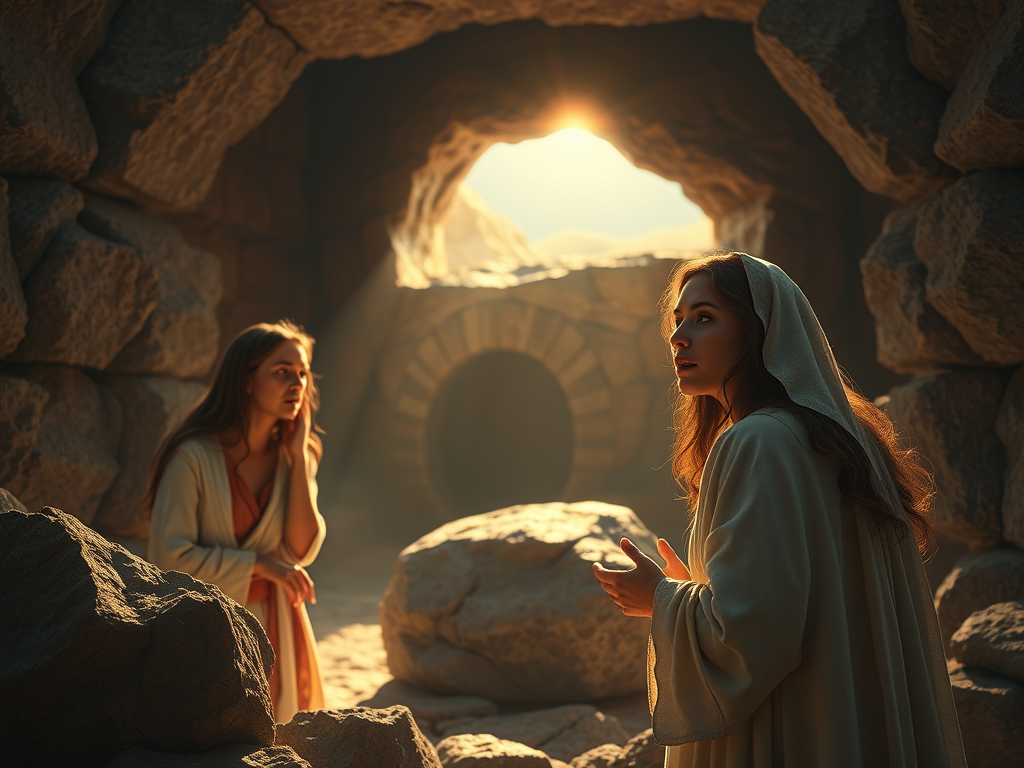
1 But at daybreak on the first day of the week they took the spices they had prepared and went to the tomb.
2
They found the stone rolled away from the tomb;
3
but when they entered, they did not find the body of the Lord Jesus.
4
While they were puzzling over this, behold, two men in dazzling garments appeared to them.
5
They were terrified and bowed their faces to the ground. They said to them, “Why do you seek the living one among the dead?
6
He is not here, but he has been raised. 2 Remember what he said to you while he was still in Galilee,
7
that the Son of Man must be handed over to sinners and be crucified, and rise on the third day.”
8
And they remembered his words.
9
3 Then they returned from the tomb and announced all these things to the eleven and to all the others.
10
The women were Mary Magdalene, Joanna, and Mary the mother of James; the others who accompanied them also told this to the apostles,
11
but their story seemed like nonsense and they did not believe them.
12
4 But Peter got up and ran to the tomb, bent down, and saw the burial cloths alone; then he went home amazed at what had happened.
13
5 6 Now that very day two of them were going to a village seven miles from Jerusalem called Emmaus,
14
and they were conversing about all the things that had occurred.
15
And it happened that while they were conversing and debating, Jesus himself drew near and walked with them,
16
7 but their eyes were prevented from recognizing him.
17
He asked them, “What are you discussing as you walk along?” They stopped, looking downcast.
18
One of them, named Cleopas, said to him in reply, “Are you the only visitor to Jerusalem who does not know of the things that have taken place there in these days?”
19
And he replied to them, “What sort of things?” They said to him, “The things that happened to Jesus the Nazarene, who was a prophet mighty in deed and word before God and all the people,
20
how our chief priests and rulers both handed him over to a sentence of death and crucified him.
21
But we were hoping that he would be the one to redeem Israel; and besides all this, it is now the third day since this took place.
22
Some women from our group, however, have astounded us: they were at the tomb early in the morning
23
and did not find his body; they came back and reported that they had indeed seen a vision of angels who announced that he was alive.
24
Then some of those with us went to the tomb and found things just as the women had described, but him they did not see.”
25
And he said to them, “Oh, how foolish you are! How slow of heart to believe all that the prophets spoke!
26
Was it not necessary that the Messiah should suffer 8 these things and enter into his glory?”
27
Then beginning with Moses and all the prophets, he interpreted to them what referred to him in all the scriptures.
28
As they approached the village to which they were going, he gave the impression that he was going on farther.
29
But they urged him, “Stay with us, for it is nearly evening and the day is almost over.” So he went in to stay with them.
30
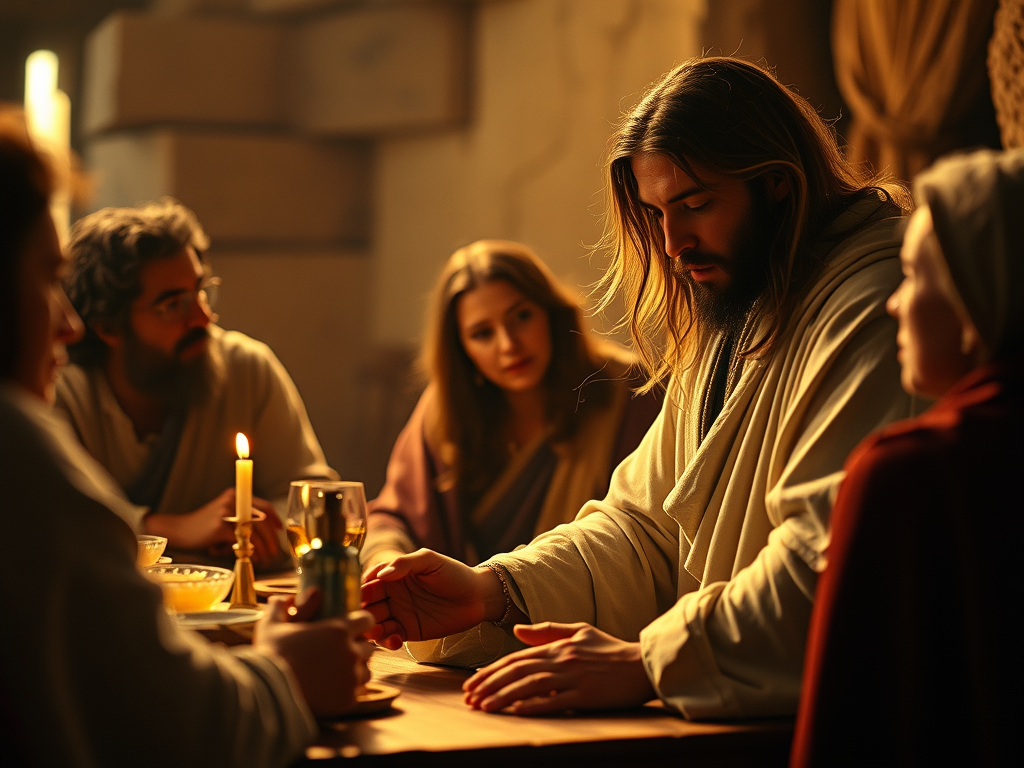
And it happened that, while he was with them at table, he took bread, said the blessing, broke it, and gave it to them.
31
With that their eyes were opened and they recognized him, but he vanished from their sight.
32
Then they said to each other, “Were not our hearts burning (within us) while he spoke to us on the way and opened the scriptures to us?”
33
So they set out at once and returned to Jerusalem where they found gathered together the eleven and those with them
34
who were saying, “The Lord has truly been raised and has appeared to Simon!”
35
Then the two recounted what had taken place on the way and how he was made known to them in the breaking of the bread.
36
9 While they were still speaking about this, he stood in their midst and said to them, “Peace be with you.”
37
But they were startled and terrified and thought that they were seeing a ghost.
38
Then he said to them, “Why are you troubled? And why do questions arise in your hearts?
39
10 Look at my hands and my feet, that it is I myself. Touch me and see, because a ghost does not have flesh and bones as you can see I have.”
40
And as he said this, he showed them his hands and his feet.
41
While they were still incredulous for joy and were amazed, he asked them, “Have you anything here to eat?”
42
They gave him a piece of baked fish;
43
he took it and ate it in front of them.
44
He said to them, “These are my words that I spoke to you while I was still with you, that everything written about me in the law of Moses and in the prophets and psalms must be fulfilled.”
45
Then he opened their minds to understand the scriptures.
46
11 And he said to them, “Thus it is written that the Messiah would suffer and rise from the dead on the third day
47
and that repentance, for the forgiveness of sins, would be preached in his name to all the nations, beginning from Jerusalem.
48
You are witnesses of these things.
49
And (behold) I am sending the promise of my Father 12 upon you; but stay in the city until you are clothed with power from on high.”
50
13 Then he led them (out) as far as Bethany, raised his hands, and blessed them.
51
As he blessed them he parted from them and was taken up to heaven.
52
They did him homage and then returned to Jerusalem with great joy,
53
and they were continually in the temple praising God. 14
1 [1-53] The resurrection narrative in Luke consists of five sec tions: (1) the women at the empty tomb (⇒ Luke 23:56b-⇒ 24:12); (2) the appearance to the two disciples on the way to Emmaus (⇒ Luke 24:13-35); (3) the appearance to the disciples in Jerusalem (⇒ Luke 24:36-43); (4) Jesus’ final instructions (⇒ Luke 24:44-49); (5) the ascension (⇒ Luke 24:50-53). In Luke, all the resurrection appearances take place in and around Jerusalem; moreover, they are all recounted as having taken place on Easter Sunday. A consistent theme throughout the narrative is that the suffering, death, and resurrection of Jesus were accomplished in fulfillment of Old Testament promises and of Jewish hopes (⇒ Luke 24:19a, ⇒ 21, ⇒ 26-27, ⇒ 44, ⇒ 46). In his second volume, Acts, Luke will argue that Christianity is the fulfillment of the hopes of Pharisaic Judaism and its logical development (see ⇒ Acts 24:10-21).
2 [6] He is not here, but he has been raised: this part of the verse is omitted in important representatives of the Western text tradition, but its presence in other text types and the slight difference in wording from ⇒ Matthew 28:6 and ⇒ Mark 16:6 argue for its retention.
3 [9] The women in this gospel do not flee from the tomb and tell no one, as in ⇒ Mark 16:8 but return and tell the disciples about their experience. The initial reaction to the testimony of the women is disbelief (⇒ Luke 24:11).
4 [12] This verse is missing from the Western textual tradition but is found in the best and oldest manuscripts of other text types.
5 [13-35] This episode focuses on the interpretation of scripture by the risen Jesus and the recognition of him in the breaking of the bread. The references to the quotations of scripture and explanation of it (⇒ Luke 24:25-27), the kerygmatic proclamation (⇒ Luke 24:34), and the liturgical gesture (⇒ Luke 24:30) suggest that the episode is primarily catechetical and liturgical rather than apologetic.
6 [13] Seven miles: literally, “sixty stades.” A stade was 607 feet. Some manuscripts read “160 stades” or more than eighteen miles. The exact location of Emmaus is disputed.
7 [16] A consistent feature of the resurrection stories is that the risen Jesus was different and initially unrecognizable (⇒ Luke 24:37; ⇒ Mark 16:12; ⇒ John 20:14; ⇒ 21:4).
8 [26] That the Messiah should suffer . . . : Luke is the only New Testament writer to speak explicitly of a suffering Messiah (⇒ Luke 24:26, ⇒ 46; ⇒ Acts 3:18; ⇒ 17:3; ⇒ 26:23). The idea of a suffering Messiah is not found in the Old Testament or in other Jewish literature prior to the New Testament period, although the idea is hinted at in ⇒ Mark 8:31-33. See the notes on ⇒ Matthew 26:63 and ⇒ 26:67-68.
9 [36-43,44-49] The Gospel of Luke, like each of the other gospels (⇒ Matthew 28:16-20; ⇒ Mark 16:14-15; ⇒ John 20:19-23), focuses on an important appearance of Jesus to the Twelve in which they are commissioned for their future ministry. As in ⇒ Luke 24:6, ⇒ 12, so in ⇒ Luke 24:36, ⇒ 40 there are omissions in the Western text.
10 [39-42] The apologetic purpose of this story is evident in the concern with the physical details and the report that Jesus ate food.
11 [46] See the note on ⇒ Luke 24:26.
12 [49] The promise of my Father: i.e., the gift of the holy Spirit.
13 [50-53] Luke brings his story about the time of Jesus to a close with the report of the ascension. He will also begin the story of the time of the church with a recounting of the ascension. In the gospel, Luke recounts the ascension of Jesus on Easter Sunday night, thereby closely associating it with the resurrection. In ⇒ Acts 1:3, ⇒ 9-11; ⇒ 13:31 he historicizes the ascension by speaking of a forty-day period between the resurrection and the ascension. The Western text omits some phrases in ⇒ Luke 24:51, ⇒ 52 perhaps to avoid any chronological conflict with Acts 1 about the time of the ascension.
14 [53] The Gospel of Luke ends as it began (⇒ Luke 1:9), in the Jerusalem temple.
![]()
The Bible – New Testament
![]()

![]()

Saint Luke
Index
1. 2. 3. 4. 5. 6. 7. 8. 9.
10. 11. 12. 13. 14. 15. 16.
17. 18. 19. 20. 21. 22. 23. 24.
![]()
.
.
.
BIBLIA – LA PALABRA DE DIOS DEL DÍA
BIBLIA – ÍNDICES
MATTHEW – MARK – LUKE – JOHN
WEB OFICIAL CAMINO DE SANTIAGO
INFORMACIÓN GENERAL DEL CAMINO
RUTAS DEL CAMINO DE SANTIAGO
VIDEOS CAMINO DE SANTIAGO
The Bible – New Testament
Saint John
Index
1. 2. 3. 4. 5. 6. 7. 8. 9. 10. 11. 12.
13. 14. 15. 16. 17. 18. 19. 20. 21.

Chapter 18
1
1 2 When he had said this, Jesus went out with his disciples across the Kidron valley to where there was a garden, into which he and his disciples entered.
2
Judas his betrayer also knew the place, because Jesus had often met there with his disciples.
3
So Judas got a band of soldiers 3 and guards from the chief priests and the Pharisees and went there with lanterns, torches, and weapons.
4
Jesus, knowing everything that was going to happen to him, went out and said to them, “Whom are you looking for?”
5
They answered him, “Jesus the Nazorean.” 4 He said to them, “I AM.” Judas his betrayer was also with them.
6
When he said to them, “I AM,” they turned away and fell to the ground.
7
So he again asked them, “Whom are you looking for?” They said, “Jesus the Nazorean.”
8
Jesus answered, “I told you that I AM. So if you are looking for me, let these men go.”
9
5 This was to fulfill what he had said, “I have not lost any of those you gave me.”
10
Then Simon Peter, who had a sword, drew it, struck the high priest’s slave, and cut off his right ear. The slave’s name was Malchus. 6
11
Jesus said to Peter, “Put your sword into its scabbard. Shall I not drink the cup 7 that the Father gave me?”
12
So the band of soldiers, the tribune, and the Jewish guards seized Jesus, bound him,
13
and brought him to Annas 8 first. He was the father-in-law of Caiaphas, who was high priest that year.
14
It was Caiaphas who had counseled the Jews that it was better that one man should die rather than the people.
15
Simon Peter and another disciple 9 followed Jesus. Now the other disciple was known to the high priest, and he entered the courtyard of the high priest with Jesus.
16
But Peter stood at the gate outside. So the other disciple, the acquaintance of the high priest, went out and spoke to the gatekeeper and brought Peter in.
17
Then the maid who was the gatekeeper said to Peter, “You are not one of this man’s disciples, are you?” He said, “I am not.”
18
Now the slaves and the guards were standing around a charcoal fire that they had made, because it was cold, and were warming themselves. Peter was also standing there keeping warm.
19
The high priest questioned Jesus about his disciples and about his doctrine.
20
Jesus answered him, “I have spoken publicly to the world. I have always taught in a synagogue or in the temple area 10 where all the Jews gather, and in secret I have said nothing.
21
Why ask me? Ask those who heard me what I said to them. They know what I said.”
22
When he had said this, one of the temple guards standing there struck Jesus and said, “Is this the way you answer the high priest?”
23
Jesus answered him, “If I have spoken wrongly, testify to the wrong; but if I have spoken rightly, why do you strike me?”
24
Then Annas sent him bound to Caiaphas 11 the high priest.
25
Now Simon Peter was standing there keeping warm. And they said to him, “You are not one of his disciples, are you?” He denied it and said, “I am not.”
26
One of the slaves of the high priest, a relative of the one whose ear Peter had cut off, said, “Didn’t I see you in the garden with him?”
27
Again Peter denied it. And immediately the cock crowed. 12
28
Then they brought Jesus from Caiaphas to the praetorium. 13 It was morning. And they themselves did not enter the praetorium, in order not to be defiled so that they could eat the Passover.
29
So Pilate came out to them and said, “What charge do you bring (against) this man?”
30
They answered and said to him, “If he were not a criminal, we would not have handed him over to you.”
31
At this, Pilate said to them, “Take him yourselves, and judge him according to your law.” The Jews answered him, “We do not have the right to execute anyone,” 14
32
15 in order that the word of Jesus might be fulfilled that he said indicating the kind of death he would die.
33
So Pilate went back into the praetorium and summoned Jesus and said to him, “Are you the King of the Jews?”
34
Jesus answered, “Do you say this on your own or have others told you about me?”
35
Pilate answered, “I am not a Jew, am I? Your own nation and the chief priests handed you over to me. What have you done?”
36
Jesus answered, “My kingdom does not belong to this world. If my kingdom did belong to this world, my attendants (would) be fighting to keep me from being handed over to the Jews. But as it is, my kingdom is not here.”
37
So Pilate said to him, “Then you are a king?” Jesus answered, “You say I am a king. 16 For this I was born and for this I came into the world, to testify to the truth. Everyone who belongs to the truth listens to my voice.”
38
Pilate said to him, “What is truth?” When he had said this, he again went out to the Jews and said to them, “I find no guilt in him.
39
But you have a custom that I release one prisoner to you at Passover. 17 Do you want me to release to you the King of the Jews?”
40
They cried out again, “Not this one but Barabbas!” 18 Now Barabbas was a revolutionary.
1 [1-14] John does not mention the agony in the garden and the kiss of Judas, nor does he identify the place as Gethsemane or the Mount of Olives.
2 [1] Jesus went out: see ⇒ John 14:31 where it seems he is leaving the supper room. Kidron valley: literally, “the winter-flowing Kidron”; this wadi has water only during the winter rains.
3 [3] Band of soldiers: seems to refer to Roman troops, either the full cohort of 600 men (1/10 of a legion), or more likely the maniple of 200 under their tribune (⇒ John 18:12). In this case, John is hinting at Roman collusion in the action against Jesus before he was brought to Pilate. The lanterns and torches may be symbolic of the hour of darkness.
4 [5] Nazorean: the form found in ⇒ Matthew 26:71 (see the note on ⇒ Matthew 2:23) is here used, not Nazarene of Mark. I AM: or “I am he,” but probably intended by the evangelist as an expression of divinity (cf their appropriate response in ⇒ John 18:6); see the note on ⇒ John 8:24. John sets the confusion of the arresting party against the background of Jesus’ divine majesty.
5 [9] The citation may refer to ⇒ John 6:39; ⇒ 10:28; or ⇒ John 17:12.
6 [10] Only John gives the names of the two antagonists; both John and Luke mention the right ear.
7 [11] The theme of the cup is found in the synoptic account of the agony (⇒ Mark 14:36 and parallels).
8 [13] Annas: only John mentions an inquiry before Annas; cf ⇒ John 18:16, ⇒ 19-24; see the note on ⇒ Luke 3:2. It is unlikely that this nighttime interrogation before Annas is the same as the trial before Caiaphas placed by Matthew and Mark at night and by Luke in the morning.
9 [15-16] Another disciple . . . the other disciple: see the note on ⇒ John 13:23.
10 [20] I have always taught . . . in the temple area: cf ⇒ Mark 14:49 for a similar statement.
11 [24] Caiaphas: see ⇒ Matthew 26:3, ⇒ 57; ⇒ Luke 3:2; and the notes there. John may leave room here for the trial before Caiaphas described in the synoptic gospels.
12 [27] Cockcrow was the third Roman division of the night, lasting from midnight to 3 A.M.
13 [28] Praetorium: see the note on ⇒ Matthew 27:27. Morning: literally, “the early hour,” or fourth Roman division of the night, 3 to 6 A.M. The Passover: the synoptic gospels give the impression that the Thursday night supper was the Passover meal (⇒ Mark 14:12); for John that meal is still to be eaten Friday night.
14 [31] We do not have the right to execute anyone: only John gives this reason for their bringing Jesus to Pilate. Jewish sources are not clear on the competence of the Sanhedrin at this period to sentence and to execute for political crimes.
15 [32] The Jewish punishment for blasphemy was stoning (⇒ Lev 24:16). In coming to the Romans to ensure that Jesus would be crucified, the Jewish authorities fulfilled his prophecy that he would be exalted (⇒ John 3:14; ⇒ 12:32-33). There is some historical evidence, however, for Jews crucifying Jews.
16 [37] You say I am a king: see ⇒ Matthew 26:64 for a similar response to the high priest. It is at best a reluctant affirmative.
17 [39] See the note on ⇒ Matthew 27:15.
18 [40] Barabbas: see the note on ⇒ Matthew 27:16-17. Revolutionary: a guerrilla warrior fighting for nationalistic aims, though the term can also denote a robber. See the note on ⇒ Matthew 27:38.
The Bible – New Testament
Saint John
Index
1. 2. 3. 4. 5. 6. 7. 8.
9. 10. 11. 12. 13. 14. 15.
16. 17. 18. 19. 20. 21.
1 Corinthians – Chapter 11
The Bible – New Testament 1 Corinthians Index 1. 2. 3. 4. 5. 6. 7. 8. 9. 10. 11. 12. 13. 14. 15. 16. Chapter 11 1 Be imitators of me, as I am of Christ. 2 1 I praise you because you remember me in everything and hold fast to the traditions, just as I… Continue reading 1 Corinthians – Chapter 11
Saint John – Chapter 12
The Bible – New Testament Saint John Index 1. 2. 3. 4. 5. 6. 7. 8. 9. 10. 11. 12. 13. 14. 15. 16. 17. 18. 19. 20. 21. Chapter 12 1 1 Six days before Passover Jesus came to Bethany, where Lazarus was, whom Jesus had raised from the dead. 2 They gave a dinner for him… Continue reading Saint John – Chapter 12
Isaiah – Chapter 42
The Bible – Old Testament Isaiah Index Int. 1. 2. 3. 4. 5. 6. 7. 8. 9. 10. 11. 12. 13. 14. 15. 16. 17. 18. 19. 20. 21. 22. 23. 24. 25. 26. 27. 28. 29. 30. 31. 32. 33. 34. 35. 36. 37. 38. 39. 40. 41. 42. 43. 44. 45. 46. 47. 48. 49. 50. 51. 52. 53. 54. 55. 56. 57. 58. 59. 60. 61. 62. 63. 64. 65. 66. Chapter 42 1 1 Here is my servant whom I uphold, my chosen one with whom I am pleased, Upon whom… Continue reading Isaiah – Chapter 42
Saint Matthew – Chapter 27
The Bible – New Testament Saint Matthew Index 1. 2. 3. 4. 5. 6. 7. 8. 9. 10. 11. 12. 13. 14. 15. 16. 17. 18. 19. 20. 21. 22. 23. 24. 25. 26. 27. 28. Chapter 27 1 1 2 When it was morning, all the chief priests and the elders of the people took counsel against Jesus to put him to death. 2 They bound… Continue reading Saint Matthew – Chapter 27
Psalms – Chapter 7
The Bible – Old Testament Psalms Index Int. 1. 2. 3. … 6. 7. 8. … 148. 149. 150. Chapter 7 1 1 A plaintive song of David, which he sang to the LORD concerning Cush, the Benjaminite. 2 LORD my God, in you I take refuge; rescue me; save me from all who pursue me, 3 Lest they maul me like lions, tear me to pieces with none to save. 4 2 LORD my God, if I am at fault in this, if there is guilt on my hands, 5 If I have repaid my friend with evil – I spared even… Continue reading Psalms – Chapter 7
Jeremiah – Chapter 11
The Bible – Old Testament Jeremiah Index Int. 1. 2. 3. 4. 5. 6. 7. 8. 9. 10. 11. 12. 13. 14. 15. 16. 17. 18. 19. 20. 21. 22. 23. 24. 25. 26. 27. 28. 29. 30. 31. 32. 33. 34. 35. 36. 37. 38. 39. 40. 41. 42. 43. 44. 45. 46. 47. 48. 49. 50. 51. 52. Chapter 11 1 The following message came to Jeremiah from the LORD: 2 Speak to the men of Judah and to… Continue reading Jeremiah – Chapter 11


You must be logged in to post a comment.