The Bible – New Testament

Saint Luke

Index

1. 2. 3. 4. 5. 6. 7. 8. 9. 10. 11. 12. 13.
14. 15. 16. 17. 18. 19. 2021. 22. 23. 24. 

Chapter 24

1

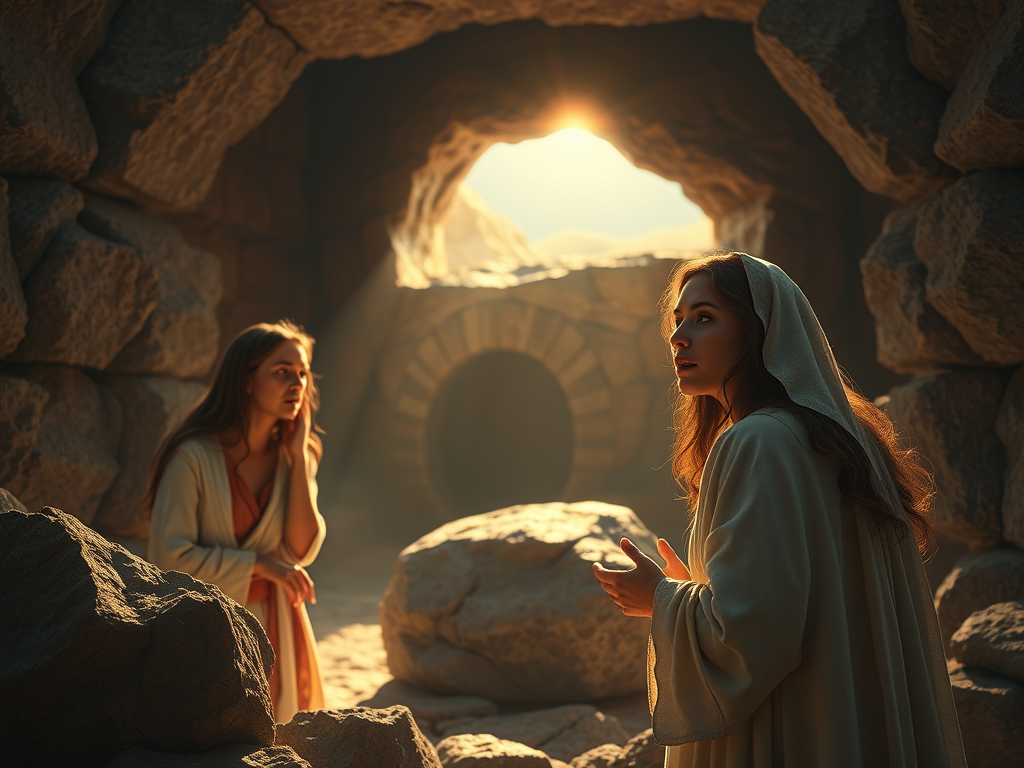
1 But at daybreak on the first day of the week they took the spices they had prepared and went to the tomb.

2

They found the stone rolled away from the tomb;

3

but when they entered, they did not find the body of the Lord Jesus.

4

While they were puzzling over this, behold, two men in dazzling garments appeared to them.

5

They were terrified and bowed their faces to the ground. They said to them, “Why do you seek the living one among the dead?

6

He is not here, but he has been raised. 2 Remember what he said to you while he was still in Galilee,

7

that the Son of Man must be handed over to sinners and be crucified, and rise on the third day.”

8

And they remembered his words.

9

3 Then they returned from the tomb and announced all these things to the eleven and to all the others.

10

The women were Mary Magdalene, Joanna, and Mary the mother of James; the others who accompanied them also told this to the apostles,

11

but their story seemed like nonsense and they did not believe them.

12

4 But Peter got up and ran to the tomb, bent down, and saw the burial cloths alone; then he went home amazed at what had happened.

13

5 6 Now that very day two of them were going to a village seven miles from Jerusalem called Emmaus,

14

and they were conversing about all the things that had occurred.

15

And it happened that while they were conversing and debating, Jesus himself drew near and walked with them,

16

7 but their eyes were prevented from recognizing him.

17

He asked them, “What are you discussing as you walk along?” They stopped, looking downcast.

18

One of them, named Cleopas, said to him in reply, “Are you the only visitor to Jerusalem who does not know of the things that have taken place there in these days?”

19

And he replied to them, “What sort of things?” They said to him, “The things that happened to Jesus the Nazarene, who was a prophet mighty in deed and word before God and all the people,

20

how our chief priests and rulers both handed him over to a sentence of death and crucified him.

21

But we were hoping that he would be the one to redeem Israel; and besides all this, it is now the third day since this took place.

22

Some women from our group, however, have astounded us: they were at the tomb early in the morning

23

and did not find his body; they came back and reported that they had indeed seen a vision of angels who announced that he was alive.

24

Then some of those with us went to the tomb and found things just as the women had described, but him they did not see.”

25

And he said to them, “Oh, how foolish you are! How slow of heart to believe all that the prophets spoke!

26

Was it not necessary that the Messiah should suffer 8 these things and enter into his glory?”

27

Then beginning with Moses and all the prophets, he interpreted to them what referred to him in all the scriptures.

28

As they approached the village to which they were going, he gave the impression that he was going on farther.

29

But they urged him, “Stay with us, for it is nearly evening and the day is almost over.” So he went in to stay with them.

30

And it happened that, while he was with them at table, he took bread, said the blessing, broke it, and gave it to them.

31

With that their eyes were opened and they recognized him, but he vanished from their sight.

32

Then they said to each other, “Were not our hearts burning (within us) while he spoke to us on the way and opened the scriptures to us?”

33

So they set out at once and returned to Jerusalem where they found gathered together the eleven and those with them

34

who were saying, “The Lord has truly been raised and has appeared to Simon!”

35

Then the two recounted what had taken place on the way and how he was made known to them in the breaking of the bread.

36

9 While they were still speaking about this, he stood in their midst and said to them, “Peace be with you.”

37

But they were startled and terrified and thought that they were seeing a ghost.

38

Then he said to them, “Why are you troubled? And why do questions arise in your hearts?

39

10 Look at my hands and my feet, that it is I myself. Touch me and see, because a ghost does not have flesh and bones as you can see I have.”

40

And as he said this, he showed them his hands and his feet.

41

While they were still incredulous for joy and were amazed, he asked them, “Have you anything here to eat?”

42

They gave him a piece of baked fish;

43

he took it and ate it in front of them.

44

He said to them, “These are my words that I spoke to you while I was still with you, that everything written about me in the law of Moses and in the prophets and psalms must be fulfilled.”

45

Then he opened their minds to understand the scriptures.

46

11 And he said to them, “Thus it is written that the Messiah would suffer and rise from the dead on the third day

47

and that repentance, for the forgiveness of sins, would be preached in his name to all the nations, beginning from Jerusalem.

48

You are witnesses of these things.

49

And (behold) I am sending the promise of my Father 12 upon you; but stay in the city until you are clothed with power from on high.”

50

13 Then he led them (out) as far as Bethany, raised his hands, and blessed them.

51

As he blessed them he parted from them and was taken up to heaven.

52

They did him homage and then returned to Jerusalem with great joy,

53

and they were continually in the temple praising God. 14

1 [1-53] The resurrection narrative in Luke consists of five sec tions: (1) the women at the empty tomb (⇒ Luke 23:56b-⇒ 24:12); (2) the appearance to the two disciples on the way to Emmaus (⇒ Luke 24:13-35); (3) the appearance to the disciples in Jerusalem (⇒ Luke 24:36-43); (4) Jesus’ final instructions (⇒ Luke 24:44-49); (5) the ascension (⇒ Luke 24:50-53). In Luke, all the resurrection appearances take place in and around Jerusalem; moreover, they are all recounted as having taken place on Easter Sunday. A consistent theme throughout the narrative is that the suffering, death, and resurrection of Jesus were accomplished in fulfillment of Old Testament promises and of Jewish hopes (⇒ Luke 24:19a, ⇒ 21, ⇒ 26-27, ⇒ 44, ⇒ 46). In his second volume, Acts, Luke will argue that Christianity is the fulfillment of the hopes of Pharisaic Judaism and its logical development (see ⇒ Acts 24:10-21).
2 [6] He is not here, but he has been raised: this part of the verse is omitted in important representatives of the Western text tradition, but its presence in other text types and the slight difference in wording from ⇒ Matthew 28:6 and ⇒ Mark 16:6 argue for its retention. 
3 [9] The women in this gospel do not flee from the tomb and tell no one, as in ⇒ Mark 16:8 but return and tell the disciples about their experience. The initial reaction to the testimony of the women is disbelief (⇒ Luke 24:11).
4 [12] This verse is missing from the Western textual tradition but is found in the best and oldest manuscripts of other text types.
5 [13-35] This episode focuses on the interpretation of scripture by the risen Jesus and the recognition of him in the breaking of the bread. The references to the quotations of scripture and explanation of it (⇒ Luke 24:25-27), the kerygmatic proclamation (⇒ Luke 24:34), and the liturgical gesture (⇒ Luke 24:30) suggest that the episode is primarily catechetical and liturgical rather than apologetic.
6 [13] Seven miles: literally, “sixty stades.” A stade was 607 feet. Some manuscripts read “160 stades” or more than eighteen miles. The exact location of Emmaus is disputed.
7 [16] A consistent feature of the resurrection stories is that the risen Jesus was different and initially unrecognizable (⇒ Luke 24:37; ⇒ Mark 16:12; ⇒ John 20:14; ⇒ 21:4).
8 [26] That the Messiah should suffer . . . : Luke is the only New Testament writer to speak explicitly of a suffering Messiah (⇒ Luke 24:26, ⇒ 46; ⇒ Acts 3:18; ⇒ 17:3; ⇒ 26:23). The idea of a suffering Messiah is not found in the Old Testament or in other Jewish literature prior to the New Testament period, although the idea is hinted at in ⇒ Mark 8:31-33. See the notes on ⇒ Matthew 26:63 and ⇒ 26:67-68.
9 [36-43,44-49] The Gospel of Luke, like each of the other gospels (⇒ Matthew 28:16-20; ⇒ Mark 16:14-15; ⇒ John 20:19-23), focuses on an important appearance of Jesus to the Twelve in which they are commissioned for their future ministry. As in ⇒ Luke 24:6, ⇒ 12, so in ⇒ Luke 24:36, ⇒ 40 there are omissions in the Western text.
10 [39-42] The apologetic purpose of this story is evident in the concern with the physical details and the report that Jesus ate food.
11 [46] See the note on ⇒ Luke 24:26.
12 [49] The promise of my Father: i.e., the gift of the holy Spirit.
13 [50-53] Luke brings his story about the time of Jesus to a close with the report of the ascension. He will also begin the story of the time of the church with a recounting of the ascension. In the gospel, Luke recounts the ascension of Jesus on Easter Sunday night, thereby closely associating it with the resurrection. In ⇒ Acts 1:3, ⇒ 9-11; ⇒ 13:31 he historicizes the ascension by speaking of a forty-day period between the resurrection and the ascension. The Western text omits some phrases in ⇒ Luke 24:51, ⇒ 52 perhaps to avoid any chronological conflict with Acts 1 about the time of the ascension.
14 [53] The Gospel of Luke ends as it began (⇒ Luke 1:9), in the Jerusalem temple.

The Bible – New Testament

Saint Luke

Index

1. 2. 3. 4. 5. 6. 7. 8. 9.

10. 11. 12. 13. 14. 15. 16.

17. 18. 19. 2021. 22. 23. 24. 

.
.

.
BIBLIA – LA PALABRA DE DIOS DEL DÍA
BIBLIA – ÍNDICES

OLD TESTAMENT –  NEW TESTAMENT

THE GOSPELS

MATTHEW – MARK – LUKE – JOHN

ORACIONES

.

.

WEB OFICIAL CAMINO DE SANTIAGO

INFORMACIÓN GENERAL DEL CAMINO
RUTAS DEL CAMINO DE SANTIAGO
VIDEOS CAMINO DE SANTIAGO

Acts – Chapter 5

The Bible – New Testament Acts Index 1. 2. 3. 4. 5. 6. 7. 8. 9. 10. 11. 12. 13. 14. 15. 16. 17. 18. 19. 20. 21. 22. 23. 24. 25. 26. 27. 28. Chapter 5 1 1 A man named Ananias, however, with his wife Sapphira, sold a piece of property. 2 He retained… Continue reading Acts – Chapter 5

The Bible – New Testament

Saint John

Index

1. 2. 3. 4. 5. 6. 7. 8. 9. 10. 11. 12.
13. 14. 15. 16. 17. 18. 19. 20. 21.

Chapter 20

1

1 2 3 On the first day of the week, Mary of Magdala came to the tomb early in the morning, while it was still dark, and saw the stone removed from the tomb.

2

So she ran 4 and went to Simon Peter and to the other disciple whom Jesus loved, and told them, “They have taken the Lord from the tomb, and we don’t know where they put him.”

3

5 So Peter and the other disciple went out and came to the tomb.

4

They both ran, but the other disciple ran faster than Peter and arrived at the tomb first;

5

he bent down and saw the burial cloths there, but did not go in.

6

When Simon Peter arrived after him, he went into the tomb and saw the burial cloths 6 there,

7

and the cloth that had covered his head, not with the burial cloths but rolled up in a separate place.

8

Then the other disciple also went in, the one who had arrived at the tomb first, and he saw and believed.

9

7 For they did not yet understand the scripture that he had to rise from the dead.

10

Then the disciples returned home.

11

8 But Mary stayed outside the tomb weeping. And as she wept, she bent over into the tomb

12

and saw two angels in white sitting there, one at the head and one at the feet where the body of Jesus had been.

13

And they said to her, “Woman, why are you weeping?” She said to them, “They have taken my Lord, and I don’t know where they laid him.”

14

When she had said this, she turned around and saw Jesus there, but did not know it was Jesus.

15

Jesus said to her, “Woman, why are you weeping? Whom are you looking for?” She thought it was the gardener and said to him, “Sir, if you carried him away, tell me where you laid him, and I will take him.”

16

Jesus said to her, “Mary!” She turned and said to him in Hebrew, “Rabbouni,” 9 which means Teacher.

17

Jesus said to her, “Stop holding on to me, 10 for I have not yet ascended to the Father. But go to my brothers and tell them, ‘I am going to my Father and your Father, to my God and your God.'”

18

Mary of Magdala went and announced to the disciples, “I have seen the Lord,” and what he told her.

19

11 12 On the evening of that first day of the week, when the doors were locked, where the disciples were, for fear of the Jews, Jesus came and stood in their midst and said to them, “Peace be with you.”

20

When he had said this, he showed them his hands and his side. 13 The disciples rejoiced when they saw the Lord.

21

14 (Jesus) said to them again, “Peace be with you. As the Father has sent me, so I send you.”

22

15 And when he had said this, he breathed on them and said to them, “Receive the holy Spirit.

23

16 Whose sins you forgive are forgiven them, and whose sins you retain are retained.”

24

Thomas, called Didymus, one of the Twelve, was not with them when Jesus came.

25

So the other disciples said to him, “We have seen the Lord.” But he said to them, “Unless I see the mark of the nails in his hands and put my finger into the nailmarks and put my hand into his side, I will not believe.”

26

Now a week later his disciples were again inside and Thomas was with them. Jesus came, although the doors were locked, and stood in their midst and said, “Peace be with you.”

27

Then he said to Thomas, “Put your finger here and see my hands, and bring your hand and put it into my side, and do not be unbelieving, but believe.”

28

17 Thomas answered and said to him, “My Lord and my God!”

29

18 Jesus said to him, “Have you come to believe because you have seen me? Blessed are those who have not seen and have believed.”

30

19 Now Jesus did many other signs in the presence of (his) disciples that are not written in this book.

31

But these are written that you may (come to) believe that Jesus is the Messiah, the Son of God, and that through this belief you may have life in his name.

1 [1-31] The risen Jesus reveals his glory and confers the Spirit. This story fulfills the basic need for testimony to the resurrection. What we have here is not a record but a series of single stories.
2 [1-10] The story of the empty tomb is found in both the Matthean and the Lucan traditions; John’s version seems to be a fusion of the two.
3 [1] Still dark: according to Mark the sun had risen, Matthew describes it as “dawning,” and Luke refers to early dawn. Mary sees the stone removed, not the empty tomb.
4 [2] Mary runs away, not directed by an angel/young man as in the synoptic accounts. The plural “we” in the second part of her statement might reflect a tradition of more women going to the tomb.
5 [3-10] The basic narrative is told of Peter alone in ⇒ Luke 24:12, a verse missing in important manuscripts and which may be borrowed from tradition similar to John. Cf also ⇒ Luke 24:24.
6 [6-8] Some special feature about the state of the burial cloths caused the beloved disciple to believe. Perhaps the details emphasized that the grave had not been robbed.
7 [9] Probably a general reference to the scriptures is intended, as in ⇒ Luke 24:26 and ⇒ 1 Cor 15:4. Some individual Old Testament passages suggested are ⇒ Psalm 16:10; ⇒ Hosea 6:2; ⇒ Jonah 2:1, 2, ⇒ 10.
8 [11-18] This appearance to Mary is found only in John, but cf ⇒ Matthew 28:8-10 and ⇒ Mark 16:9-11.
9 [16] Rabbouni: Hebrew or Aramaic for “my master.”
10 [17] Stop holding on to me: see ⇒ Matthew 28:9, where the women take hold of his feet. I have not yet ascended: for John and many of the New Testament writers, the ascension in the theological sense of going to the Father to be glorified took place with the resurrection as one action. This scene in John dramatizes such an understanding, for by Easter night Jesus is glorified and can give the Spirit. Therefore his ascension takes place immediately after he has talked to Mary. In such a view, the ascension after forty days described in ⇒ Acts 1:1-11 would be simply a termination of earthly appearances or, perhaps better, an introduction to the conferral of the Spirit upon the early church, modeled on Elisha’s being able to have a (double) share in the spirit of Elijah if he saw him being taken up (same verb as ascending) into heaven (⇒ 2 Kings 2:9-12). To my Father and your Father, to my God and your God: this echoes ⇒ Ruth 1:16: “Your people shall be my people, and your God my God.” The Father of Jesus will now become the Father of the disciples because, once ascended, Jesus can give them the Spirit that comes from the Father and they can be reborn as God’s children (⇒ John 3:5). That is why he calls them my brothers.
11 [19-29] The appearances to the disciples, without or with Thomas (cf ⇒ John 11:16; ⇒ 14:5), have rough parallels in the other gospels only for ⇒ John 20:19-23; cf ⇒ Luke 24:36-39; ⇒ Mark 16:14-18.
12 [19] The disciples: by implication from ⇒ John 20:24 this means ten of the Twelve, presumably in Jerusalem. Peace be with you: although this could be an ordinary greeting, John intends here to echo ⇒ John 14:27. The theme of rejoicing in ⇒ John 20:20 echoes ⇒ John 16:22.
13 [20] Hands and . . . side: ⇒ Luke 24:39-40 mentions “hands and feet,” based on ⇒ Psalm 22:17.
14 [21] By means of this sending, the Eleven were made apostles, that is, “those sent” (cf ⇒ John 17:18), though John does not use the noun in reference to them (see the note on ⇒ John 13:16). A solemn mission or “sending” is also the subject of the post-resurrection appearances to the Eleven in ⇒ Matthew 28:19; ⇒ Luke 24:47; ⇒ Mark 16:15.
15 [22] This action recalls ⇒ Genesis 2:7, where God breathed on the first man and gave him life; just as Adam’s life came from God, so now the disciples’ new spiritual life comes from Jesus. Cf also the revivification of the dry bones in Ezekial 37. This is the author’s version of Pentecost. Cf also the note on ⇒ John 19:30.
16 [23] The Council of Trent defined that this power to forgive sins is exercised in the sacrament of penance. See ⇒ Matthew 16:19; ⇒ Matthew 18:18.
17 [28] My Lord and my God: this forms a literary inclusion with the first verse of the gospel: “and the Word was God.”
18 [29] This verse is a beatitude on future generations; faith, not sight, matters.
19 [30-31] These verses are clearly a conclusion to the gospel and express its purpose. While many manuscripts read come to believe, possibly implying a missionary purpose for John’s gospel, a small number of quite early ones read “continue to believe,” suggesting that the audience consists of Christians whose faith is to be deepened by the book; cf ⇒ John 19:35.

The Bible – New Testament

Saint John

Index 

1. 2. 3. 4. 5. 6. 7. 8.

9. 10. 11. 12. 13. 14. 15.

16. 17. 18. 19. 20. 21.

Word of the day

Bible on table top

06/05/2025

Tuesday of the Third Week of Easter

Reading of the day

A reading from the Book of the Acts of the Apostles
Acts 7:51—8:1a

Stephen said to the people, the elders, and the scribes:
“You stiff-necked people, uncircumcised in heart and ears,
you always oppose the Holy Spirit;
you are just like your ancestors.
Which of the prophets did your ancestors not persecute?
They put to death those who foretold the coming of the righteous one,
whose betrayers and murderers you have now become.
You received the law as transmitted by angels,
but you did not observe it.”

When they heard this, they were infuriated,
and they ground their teeth at him.
But Stephen, filled with the Holy Spirit,
looked up intently to heaven and saw the glory of God
and Jesus standing at the right hand of God,
and Stephen said, “Behold, I see the heavens opened
and the Son of Man standing at the right hand of God.”
But they cried out in a loud voice,
covered their ears, and rushed upon him together.
They threw him out of the city, and began to stone him.
The witnesses laid down their cloaks
at the feet of a young man named Saul.
As they were stoning Stephen, he called out,
“Lord Jesus, receive my spirit.”
Then he fell to his knees and cried out in a loud voice,
“Lord, do not hold this sin against them”;
and when he said this, he fell asleep.

Now Saul was consenting to his execution.

Gospel of the day

From the Gospel according to John
John 6:30-35

The crowd said to Jesus:
“What sign can you do, that we may see and believe in you?
What can you do?
Our ancestors ate manna in the desert, as it is written:

He gave them bread from heaven to eat.”

So Jesus said to them,
“Amen, amen, I say to you,
it was not Moses who gave the bread from heaven;
my Father gives you the true bread from heaven.
For the bread of God is that which comes down from heaven
and gives life to the world.”

So they said to Jesus,
“Sir, give us this bread always.”
Jesus said to them, “I am the bread of life;
whoever comes to me will never hunger,
and whoever believes in me will never thirst.”

Word of the day

30/04/2025

Wednesday of the Second Week of Easter

Reading of the day

A reading from the Book of the Acts of the Apostles
Acts 5:17-26

The high priest rose up and all his companions,
that is, the party of the Sadducees,
and, filled with jealousy,
laid hands upon the Apostles and put them in the public jail.
But during the night, the angel of the Lord opened the doors of the prison,
led them out, and said,
“Go and take your place in the temple area,
and tell the people everything about this life.”
When they heard this,
they went to the temple early in the morning and taught.
When the high priest and his companions arrived,
they convened the Sanhedrin,
the full senate of the children of Israel,
and sent to the jail to have them brought in.
But the court officers who went did not find them in the prison,
so they came back and reported,
“We found the jail securely locked
and the guards stationed outside the doors,
but when we opened them, we found no one inside.”
When the captain of the temple guard and the chief priests heard this report,
they were at a loss about them,
as to what this would come to.
Then someone came in and reported to them,
“The men whom you put in prison are in the temple area
and are teaching the people.”
Then the captain and the court officers went and brought them,
but without force,
because they were afraid of being stoned by the people.

Gospel of the day

From the Gospel according to John
3:16-21

God so loved the world that he gave his only-begotten Son,
so that everyone who believes in him might not perish
but might have eternal life.
For God did not send his Son into the world to condemn the world,
but that the world might be saved through him.
Whoever believes in him will not be condemned,
but whoever does not believe has already been condemned,
because he has not believed in the name of the only-begotten Son of God.
And this is the verdict,
that the light came into the world,
but people preferred darkness to light,
because their works were evil.
For everyone who does wicked things hates the light
and does not come toward the light,
so that his works might not be exposed.
But whoever lives the truth comes to the light,
so that his works may be clearly seen as done in God.

Words of the Holy Father

The coming of Jesus into the world leads to a choice: whoever chooses darkness will face a judgment of condemnation; whoever chooses light will have a judgment of salvation. The judgement is always the consequence of the free choice of each person: whoever practices evil seeks the darkness; evil always hides, it covers itself. Whoever seeks the truth, that is, who practices what is good, comes to the light, illuminates the paths of life. Whoever walks in the light, whoever approaches the light, cannot but do good works. The light leads us to do good works. This is what we are called to do with greater dedication during Lent: to welcome the light into our conscience, to open our hearts to God’s infinite love, to his mercy full of tenderness and goodness, to his forgiveness. Do not forget that God always forgives, always, if we humbly ask for forgiveness. It is enough just to ask for forgiveness, and he forgives. In this way we will find true joy and will be able to rejoice in God’s forgiveness, which regenerates and gives life. (Angelus, 14 March 2021)

Word of the day

26/04/2025

Saturday in the Octave of Easter

Reading of the day

A reading from the Acts of the Apostles
Acts 4:13-21

Observing the boldness of Peter and John
and perceiving them to be uneducated, ordinary men,
the leaders, elders, and scribes were amazed,
and they recognized them as the companions of Jesus.
Then when they saw the man who had been cured standing there with them,
they could say nothing in reply.
So they ordered them to leave the Sanhedrin,
and conferred with one another, saying,
“What are we to do with these men?
Everyone living in Jerusalem knows that a remarkable sign
was done through them, and we cannot deny it.
But so that it may not be spread any further among the people,
let us give them a stern warning
never again to speak to anyone in this name.”

So they called them back
and ordered them not to speak or teach at all in the name of Jesus.
Peter and John, however, said to them in reply,
“Whether it is right in the sight of God
for us to obey you rather than God, you be the judges.
It is impossible for us not to speak about what we have seen and heard.”
After threatening them further,
they released them,
finding no way to punish them,
on account of the people who were all praising God
for what had happened.

Gospel of the day

From the Gospel according to Mark
Mark 16:9-15

When Jesus had risen, early on the first day of the week,
he appeared first to Mary Magdalene,
out of whom he had driven seven demons.
She went and told his companions who were mourning and weeping.
When they heard that he was alive
and had been seen by her, they did not believe.

After this he appeared in another form
to two of them walking along on their way to the country.
They returned and told the others;
but they did not believe them either.

But later, as the Eleven were at table, he appeared to them
and rebuked them for their unbelief and hardness of heart
because they had not believed those
who saw him after he had been raised.
He said to them, “Go into the whole world
and proclaim the Gospel to every creature.”

Words of the Holy Father

In the Gospel (…) there is the sending forth by the Lord. The Lord reveals Himself as Saviour, as the only Son of God; He revealed Himself to all Israel, all the people, especially and with more details to the apostles, to the disciples. (…) when He appeared to the eleven, He said to them: “Go into the whole world; proclaim the Good News to every creature” (Mk 16:15). This is the missionary dimension of faith. Either faith has a missionary dimension, or it is not faith. Faith is not something only for myself, so that I may grow with faith: this is a gnostic heresy. Faith always leads you to come out of yourself, to go out. The transmission of faith; faith must be transmitted, it must be offered, above all by witness: “Go, so that the people see how you live” (see v. 15). (…) But where is the certainty? How can we be sure that by going out of ourselves we will be fruitful in the transmission of the faith? “Proclaim the Good News to every creature” (Mk 16:15) and you will work wonders (see vv. 17-18). And the Lord will be with us until the end of the world. In the transmission of ideologies there are teachers but when I act out of faith, the Lord accompanies me. I am never alone in the transmission of faith. (Santa Marta, 25 April 2020)

Word of the day

24/04/2025

Thursday in the Octave of Easter

Reading of the day

A reading from the Book of the Acts of the Apostles
Acts 3:11-26

As the crippled man who had been cured clung to Peter and John,
all the people hurried in amazement toward them
in the portico called “Solomon’s Portico.”
When Peter saw this, he addressed the people,
“You children of Israel, why are you amazed at this,
and why do you look so intently at us
as if we had made him walk by our own power or piety?
The God of Abraham, the God of Isaac, and the God of Jacob,
the God of our fathers, has glorified his servant Jesus
whom you handed over and denied in Pilate’s presence,
when he had decided to release him.
You denied the Holy and Righteous One
and asked that a murderer be released to you.
The author of life you put to death,
but God raised him from the dead; of this we are witnesses.
And by faith in his name,
this man, whom you see and know, his name has made strong,
and the faith that comes through it
has given him this perfect health,
in the presence of all of you.
Now I know, brothers and sisters,
that you acted out of ignorance, just as your leaders did;
but God has thus brought to fulfillment
what he had announced beforehand
through the mouth of all the prophets,
that his Christ would suffer.
Repent, therefore, and be converted, that your sins may be wiped away,
and that the Lord may grant you times of refreshment
and send you the Christ already appointed for you, Jesus,
whom heaven must receive until the times of universal restoration
of which God spoke through the mouth
of his holy prophets from of old.
For Moses said:

A prophet like me will the Lord, your God, raise up for you
from among your own kin;
to him you shall listen in all that he may say to you.
Everyone who does not listen to that prophet
will be cut off from the people.

“Moreover, all the prophets who spoke,
from Samuel and those afterwards, also announced these days.
You are the children of the prophets
and of the covenant that God made with your ancestors
when he said to Abraham,
In your offspring all the families of the earth shall be blessed.
For you first, God raised up his servant and sent him to bless you
by turning each of you from your evil ways.”

Gospel of the day

From the Gospel according to Luke
24:35-48

The disciples of Jesus recounted what had taken place along the way,
and how they had come to recognize him in the breaking of bread.

While they were still speaking about this,
he stood in their midst and said to them,
“Peace be with you.”
But they were startled and terrified
and thought that they were seeing a ghost.
Then he said to them, “Why are you troubled?
And why do questions arise in your hearts?
Look at my hands and my feet, that it is I myself.
Touch me and see, because a ghost does not have flesh and bones
as you can see I have.”
And as he said this,
he showed them his hands and his feet.
While they were still incredulous for joy and were amazed,
he asked them, “Have you anything here to eat?”
They gave him a piece of baked fish;
he took it and ate it in front of them.

He said to them,
“These are my words that I spoke to you while I was still with you,
that everything written about me in the law of Moses
and in the prophets and psalms must be fulfilled.”
Then he opened their minds to understand the Scriptures.
And he said to them,
“Thus it is written that the Christ would suffer
and rise from the dead on the third day
and that repentance, for the forgiveness of sins,
would be preached in his name
to all the nations, beginning from Jerusalem.
You are witnesses of these things.”

Words of the Holy Father

There is a detail here, in this description. The Gospel says that the Apostles “still disbelieved for joy”. The joy they felt was such that they could not believe that this was true. And a second detail: they were bewildered, astonished; astonished because the encounter with God always leads you to astonishment: it goes beyond enthusiasm, beyond joy; it is another experience. (…) This Gospel passage tells us that Jesus is not a “ghost”, but a living Person; that when Jesus draws near to us he fills us with joy, to the point of disbelief. (…) Being Christian is not first of all a doctrine or a moral ideal; it is a living relationship with him, with the Risen Lord… (Regina Caeli, 18 April 2021)
error: Content is protected !!