21/09/2025 – Domingo de la 25ª semana de Tiempo Ordinario. PRIMERA LECTURA Contra los que compran al indigente por plata. Lectura de la profecía de Amos 8, 4-7 Escuchad esto, los que pisoteáis al pobre y elimináis a los humildes del país, diciendo: «¿Cuándo pasará la luna nueva, para vender el grano, y el sábado,… Continue reading 21/09/2025 – Domingo de la 25ª semana de Tiempo Ordinario.
Category: SUNDAY – BIBLE – THE GLOBAL WORD OF THE DAY
14/09/2025 – Domingo de la 24ª semana de Tiempo Ordinario. La Exaltación de la Santa Cruz.
14/09/2025 – Domingo de la 24ª semana de Tiempo Ordinario. La Exaltación de la Santa Cruz. PRIMERA LECTURA Cuando una serpiente mordía a alguien, este miraba a la serpiente de bronce y salvaba la vida. Lectura del libro de los Números 21, 4b-9 En aquellos días, el pueblo ese cansó de caminar y habló… Continue reading 14/09/2025 – Domingo de la 24ª semana de Tiempo Ordinario. La Exaltación de la Santa Cruz.
The Bible – New Testament
![]()

![]()
Saint John
Index
1. 2. 3. 4. 5. 6. 7. 8. 9. 10. 11. 12.
13. 14. 15. 16. 17. 18. 19. 20. 21.
![]()

![]()
Chapter 20
1
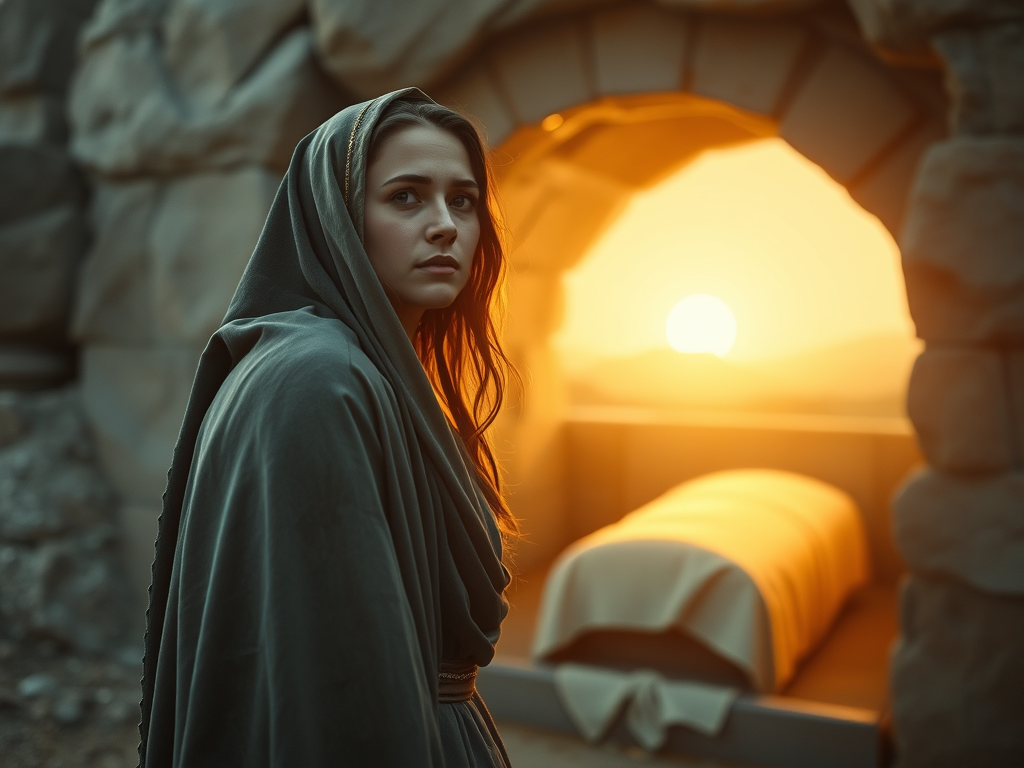
1 2 3 On the first day of the week, Mary of Magdala came to the tomb early in the morning, while it was still dark, and saw the stone removed from the tomb.
2
So she ran 4 and went to Simon Peter and to the other disciple whom Jesus loved, and told them, “They have taken the Lord from the tomb, and we don’t know where they put him.”
3
5 So Peter and the other disciple went out and came to the tomb.
4
They both ran, but the other disciple ran faster than Peter and arrived at the tomb first;
5
he bent down and saw the burial cloths there, but did not go in.
6
When Simon Peter arrived after him, he went into the tomb and saw the burial cloths 6 there,
7
and the cloth that had covered his head, not with the burial cloths but rolled up in a separate place.
8
Then the other disciple also went in, the one who had arrived at the tomb first, and he saw and believed.
9
7 For they did not yet understand the scripture that he had to rise from the dead.
10
Then the disciples returned home.
11
8 But Mary stayed outside the tomb weeping. And as she wept, she bent over into the tomb
12
and saw two angels in white sitting there, one at the head and one at the feet where the body of Jesus had been.
13
And they said to her, “Woman, why are you weeping?” She said to them, “They have taken my Lord, and I don’t know where they laid him.”
14
When she had said this, she turned around and saw Jesus there, but did not know it was Jesus.
15
Jesus said to her, “Woman, why are you weeping? Whom are you looking for?” She thought it was the gardener and said to him, “Sir, if you carried him away, tell me where you laid him, and I will take him.”
16
Jesus said to her, “Mary!” She turned and said to him in Hebrew, “Rabbouni,” 9 which means Teacher.
17
Jesus said to her, “Stop holding on to me, 10 for I have not yet ascended to the Father. But go to my brothers and tell them, ‘I am going to my Father and your Father, to my God and your God.'”
18
Mary of Magdala went and announced to the disciples, “I have seen the Lord,” and what he told her.
19
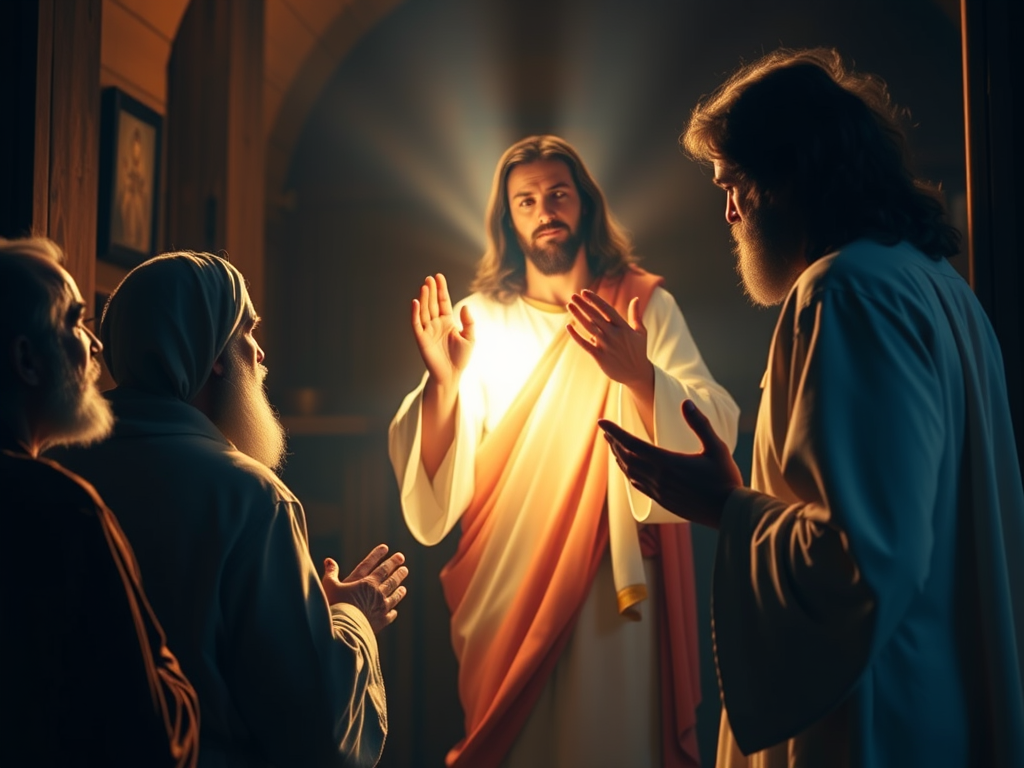
11 12 On the evening of that first day of the week, when the doors were locked, where the disciples were, for fear of the Jews, Jesus came and stood in their midst and said to them, “Peace be with you.”
20
When he had said this, he showed them his hands and his side. 13 The disciples rejoiced when they saw the Lord.
21
14 (Jesus) said to them again, “Peace be with you. As the Father has sent me, so I send you.”
22
15 And when he had said this, he breathed on them and said to them, “Receive the holy Spirit.
23
16 Whose sins you forgive are forgiven them, and whose sins you retain are retained.”
24
Thomas, called Didymus, one of the Twelve, was not with them when Jesus came.
25
So the other disciples said to him, “We have seen the Lord.” But he said to them, “Unless I see the mark of the nails in his hands and put my finger into the nailmarks and put my hand into his side, I will not believe.”
26
Now a week later his disciples were again inside and Thomas was with them. Jesus came, although the doors were locked, and stood in their midst and said, “Peace be with you.”
27
Then he said to Thomas, “Put your finger here and see my hands, and bring your hand and put it into my side, and do not be unbelieving, but believe.”
28
17 Thomas answered and said to him, “My Lord and my God!”
29
18 Jesus said to him, “Have you come to believe because you have seen me? Blessed are those who have not seen and have believed.”
30
19 Now Jesus did many other signs in the presence of (his) disciples that are not written in this book.
31
But these are written that you may (come to) believe that Jesus is the Messiah, the Son of God, and that through this belief you may have life in his name.
![]()
1 [1-31] The risen Jesus reveals his glory and confers the Spirit. This story fulfills the basic need for testimony to the resurrection. What we have here is not a record but a series of single stories.
2 [1-10] The story of the empty tomb is found in both the Matthean and the Lucan traditions; John’s version seems to be a fusion of the two.
3 [1] Still dark: according to Mark the sun had risen, Matthew describes it as “dawning,” and Luke refers to early dawn. Mary sees the stone removed, not the empty tomb.
4 [2] Mary runs away, not directed by an angel/young man as in the synoptic accounts. The plural “we” in the second part of her statement might reflect a tradition of more women going to the tomb.
5 [3-10] The basic narrative is told of Peter alone in ⇒ Luke 24:12, a verse missing in important manuscripts and which may be borrowed from tradition similar to John. Cf also ⇒ Luke 24:24.
6 [6-8] Some special feature about the state of the burial cloths caused the beloved disciple to believe. Perhaps the details emphasized that the grave had not been robbed.
7 [9] Probably a general reference to the scriptures is intended, as in ⇒ Luke 24:26 and ⇒ 1 Cor 15:4. Some individual Old Testament passages suggested are ⇒ Psalm 16:10; ⇒ Hosea 6:2; ⇒ Jonah 2:1, 2, ⇒ 10.
8 [11-18] This appearance to Mary is found only in John, but cf ⇒ Matthew 28:8-10 and ⇒ Mark 16:9-11.
9 [16] Rabbouni: Hebrew or Aramaic for “my master.”
10 [17] Stop holding on to me: see ⇒ Matthew 28:9, where the women take hold of his feet. I have not yet ascended: for John and many of the New Testament writers, the ascension in the theological sense of going to the Father to be glorified took place with the resurrection as one action. This scene in John dramatizes such an understanding, for by Easter night Jesus is glorified and can give the Spirit. Therefore his ascension takes place immediately after he has talked to Mary. In such a view, the ascension after forty days described in ⇒ Acts 1:1-11 would be simply a termination of earthly appearances or, perhaps better, an introduction to the conferral of the Spirit upon the early church, modeled on Elisha’s being able to have a (double) share in the spirit of Elijah if he saw him being taken up (same verb as ascending) into heaven (⇒ 2 Kings 2:9-12). To my Father and your Father, to my God and your God: this echoes ⇒ Ruth 1:16: “Your people shall be my people, and your God my God.” The Father of Jesus will now become the Father of the disciples because, once ascended, Jesus can give them the Spirit that comes from the Father and they can be reborn as God’s children (⇒ John 3:5). That is why he calls them my brothers.
11 [19-29] The appearances to the disciples, without or with Thomas (cf ⇒ John 11:16; ⇒ 14:5), have rough parallels in the other gospels only for ⇒ John 20:19-23; cf ⇒ Luke 24:36-39; ⇒ Mark 16:14-18.
12 [19] The disciples: by implication from ⇒ John 20:24 this means ten of the Twelve, presumably in Jerusalem. Peace be with you: although this could be an ordinary greeting, John intends here to echo ⇒ John 14:27. The theme of rejoicing in ⇒ John 20:20 echoes ⇒ John 16:22.
13 [20] Hands and . . . side: ⇒ Luke 24:39-40 mentions “hands and feet,” based on ⇒ Psalm 22:17.
14 [21] By means of this sending, the Eleven were made apostles, that is, “those sent” (cf ⇒ John 17:18), though John does not use the noun in reference to them (see the note on ⇒ John 13:16). A solemn mission or “sending” is also the subject of the post-resurrection appearances to the Eleven in ⇒ Matthew 28:19; ⇒ Luke 24:47; ⇒ Mark 16:15.
15 [22] This action recalls ⇒ Genesis 2:7, where God breathed on the first man and gave him life; just as Adam’s life came from God, so now the disciples’ new spiritual life comes from Jesus. Cf also the revivification of the dry bones in Ezekial 37. This is the author’s version of Pentecost. Cf also the note on ⇒ John 19:30.
16 [23] The Council of Trent defined that this power to forgive sins is exercised in the sacrament of penance. See ⇒ Matthew 16:19; ⇒ Matthew 18:18.
17 [28] My Lord and my God: this forms a literary inclusion with the first verse of the gospel: “and the Word was God.”
18 [29] This verse is a beatitude on future generations; faith, not sight, matters.
19 [30-31] These verses are clearly a conclusion to the gospel and express its purpose. While many manuscripts read come to believe, possibly implying a missionary purpose for John’s gospel, a small number of quite early ones read “continue to believe,” suggesting that the audience consists of Christians whose faith is to be deepened by the book; cf ⇒ John 19:35.
![]()
The Bible – New Testament
![]()

![]()
Saint John
Index
1. 2. 3. 4. 5. 6. 7. 8.
9. 10. 11. 12. 13. 14. 15.
16. 17. 18. 19. 20. 21.
![]()
![]()
Saint John – Chapter 21
The Bible – New Testament Saint John Index 1. 2. 3. 4. 5. 6. 7. 8. 9. 10. 11. 12. 13. 14. 15. 16. 17. 18. 19. 20. 21. Chapter 21 1 1 After this, Jesus revealed himself again to his disciples at the Sea of Tiberias. He revealed himself in this way. 2 Together were Simon Peter,… Continue reading Saint John – Chapter 21
The Bible – Old Testament
Psalms
Index
Int. 1. 2. 3. … 14. 15. 16. … 149. 150.

Chapter 15
1
1 2 A psalm of David. LORD, who may abide in your tent? Who may dwell on your holy mountain?
2
IWhoever walks without blame, doing what is right, speaking truth from the heart;
3
Who does not slander a neighbor, does no harm to another, never defames a friend;
4
Who disdains the wicked, but honors those who fear the LORD; Who keeps an oath despite the cost,
5
3 lends no money at interest, accepts no bribe against the innocent. III Whoever acts like this shall never be shaken.
![]()
1 [Psalm 15] The psalm records a liturgical scrutiny at the entrance to the temple court (cf ⇒ Psalm 24:3-6; ⇒ Isaiah 33:14b-16). The Israelite wishing to be admitted had to ask the temple official what conduct was appropriate to God’s precincts. Note the emphasis on virtues relating to one’s neighbor.
2 [1] Your tent . . . your holy mountain: the temple could be referred to as “tent” (⇒ Psalm 61:5; ⇒ Isaiah 33:20), a reference to the tent of the wilderness period and the tent of David (⇒ 2 Sam 6:17; ⇒ 7:2), predecessors of the temple. Holy mountain: a venerable designation of the divine abode (⇒ Psalm 2:6; ⇒ 3:5; ⇒ 43:3; ⇒ 48:2 etc.).
3 [5] Lends no money at interest: lending money in the Old Testament was often seen as assistance to the poor in their distress, not as an investment; making money off the poor by charging interest was thus forbidden (⇒ Exodus 22:24; ⇒ Lev 25:36-37; ⇒ Deut 23:20).
![]()
The Bible – Old Testament

Psalms
Index
Int. 1. 2. 3. … 14. 15. 16. … 149. 150.
![]()
Word of the day
![]()

![]()
01/06/2025
Solemnity of the Ascension of the Lord
Reading of the day
A reading from the Acts of the Apostlesa
Acts 1:1-11
In the first book, Theophilus,
I dealt with all that Jesus did and taught
until the day he was taken up,
after giving instructions through the Holy Spirit
to the apostles whom he had chosen.
He presented himself alive to them
by many proofs after he had suffered,
appearing to them during forty days
and speaking about the kingdom of God.
While meeting with them,
he enjoined them not to depart from Jerusalem,
but to wait for “the promise of the Father
about which you have heard me speak;
for John baptized with water,
but in a few days you will be baptized with the Holy Spirit.”
When they had gathered together they asked him,
“Lord, are you at this time going to restore the kingdom to Israel?”
He answered them, “It is not for you to know the times or seasons
that the Father has established by his own authority.
But you will receive power when the Holy Spirit comes upon you,
and you will be my witnesses in Jerusalem,
throughout Judea and Samaria,
and to the ends of the earth.”
When he had said this, as they were looking on,
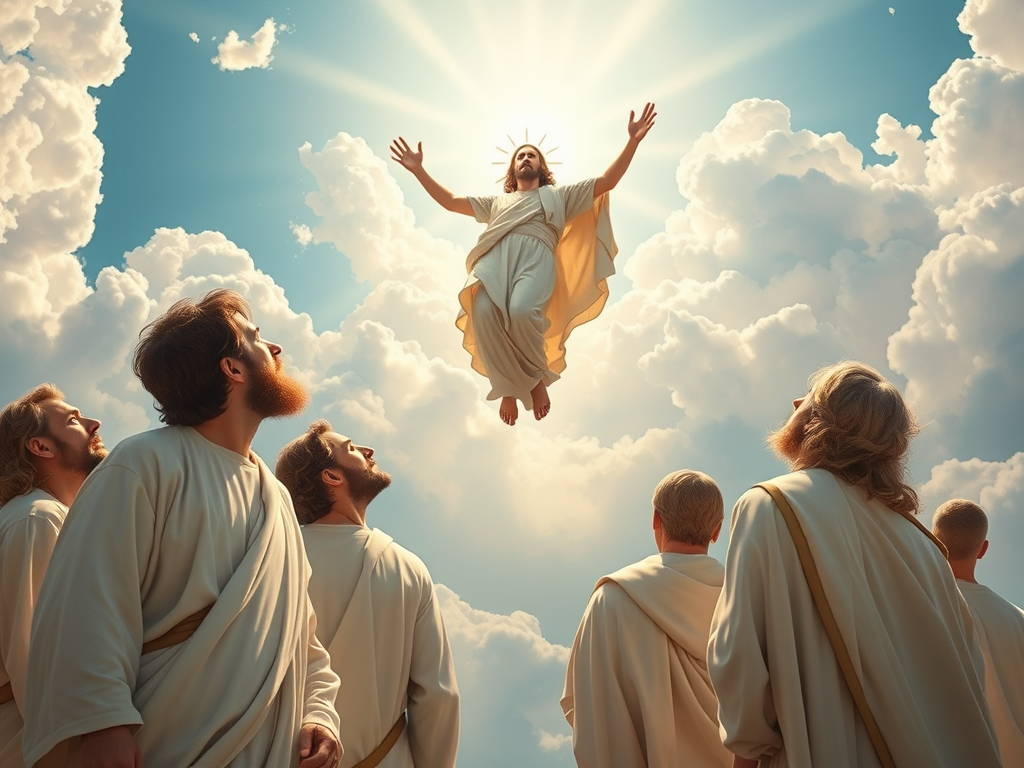
he was lifted up, and a cloud took him from their sight.
While they were looking intently at the sky as he was going,
suddenly two men dressed in white garments stood beside them.
They said, “Men of Galilee,
why are you standing there looking at the sky?
This Jesus who has been taken up from you into heaven
will return in the same way as you have seen him going into heaven.”
A reading from the Letter to the Hebrews
Heb 9:24-28; 10:19-23
Christ did not enter into a sanctuary made by hands,
a copy of the true one, but heaven itself,
that he might now appear before God on our behalf.
Not that he might offer himself repeatedly,
as the high priest enters each year into the sanctuary
with blood that is not his own;
if that were so, he would have had to suffer repeatedly
from the foundation of the world.
But now once for all he has appeared at the end of the ages
to take away sin by his sacrifice.
Just as it is appointed that men and women die once,
and after this the judgment, so also Christ,
offered once to take away the sins of many,
will appear a second time, not to take away sin
but to bring salvation to those who eagerly await him.
Therefore, brothers and sisters, since through the blood of Jesus
we have confidence of entrance into the sanctuary
by the new and living way he opened for us through the veil,
that is, his flesh,
and since we have “a great priest over the house of God,”
let us approach with a sincere heart and in absolute trust,
with our hearts sprinkled clean from an evil conscience
and our bodies washed in pure water.
Let us hold unwaveringly to our confession that gives us hope,
for he who made the promise is trustworthy.
Gospel of the day
From the Gospel according to Luke
24:46-53
Jesus said to his disciples:
“Thus it is written that the Christ would suffer
and rise from the dead on the third day
and that repentance, for the forgiveness of sins,
would be preached in his name
to all the nations, beginning from Jerusalem.
You are witnesses of these things.
And behold I am sending the promise of my Father upon you;
but stay in the city
until you are clothed with power from on high.”
Then he led them out as far as Bethany,
raised his hands, and blessed them.
As he blessed them he parted from them
and was taken up to heaven.
They did him homage
and then returned to Jerusalem with great joy,
and they were continually in the temple praising God.
The words of the Popes
The Ascension does not point to Jesus’ absence, but tells us that he is alive in our midst in a new way. He is no longer in a specific place in the world as he was before the Ascension. He is now in the lordship of God, present in every space and time, close to each one of us. In our life we are never alone: we have this Advocate who awaits us, who defends us. We are never alone: the Crucified and Risen Lord guides us. We have with us a multitude of brothers and sisters who, in silence and concealment, in their family life and at work, in their problems and hardships, in their joys and hopes, live faith daily and together with us bring the world the lordship of God’s love, in the Risen Jesus Christ, ascended into Heaven, our own Advocate. (Pope Francis, General Audience, 17 April 2013)
![]()

![]()

![]()
Revelation – Chapter 21
The Bible – New Testament Revelation Index 1. 2. 3. 4. 5. 6. 7. 8. 9. 10. 11. 12. 13. 14. 15. 16. 17. 18. 19. 20. 21. 22. Chapter 21 1 1 Then I saw a new heaven and a new earth. The former heaven and the former earth had passed away, and the sea was… Continue reading Revelation – Chapter 21
Word of the day

25/05/2025
Sixth Sunday of Easter
Reading of the day
A reading from the Book of the Acts of the Apostles
Acts 15:1-2, 22-29
Some who had come down from Judea were instructing the brothers,
“Unless you are circumcised according to the Mosaic practice,
you cannot be saved.”
Because there arose no little dissension and debate
by Paul and Barnabas with them,
it was decided that Paul, Barnabas, and some of the others
should go up to Jerusalem to the apostles and elders
about this question.
The apostles and elders, in agreement with the whole church,
decided to choose representatives
and to send them to Antioch with Paul and Barnabas.
The ones chosen were Judas, who was called Barsabbas,
and Silas, leaders among the brothers.
This is the letter delivered by them:
“The apostles and the elders, your brothers,
to the brothers in Antioch, Syria, and Cilicia
of Gentile origin: greetings.
Since we have heard that some of our number
who went out without any mandate from us
have upset you with their teachings
and disturbed your peace of mind,
we have with one accord decided to choose representatives
and to send them to you along with our beloved Barnabas and Paul,
who have dedicated their lives to the name of our Lord Jesus Christ.
So we are sending Judas and Silas
who will also convey this same message by word of mouth:
‘It is the decision of the Holy Spirit and of us
not to place on you any burden beyond these necessities,
namely, to abstain from meat sacrificed to idols,
from blood, from meats of strangled animals,
and from unlawful marriage.
If you keep free of these,
you will be doing what is right. Farewell.’”
A reading from the Book of Revelation
Rev 21:10-14, 22-23
The angel took me in spirit to a great, high mountain
and showed me the holy city Jerusalem
coming down out of heaven from God.
It gleamed with the splendor of God.
Its radiance was like that of a precious stone,
like jasper, clear as crystal.
It had a massive, high wall,
with twelve gates where twelve angels were stationed
and on which names were inscribed,
the names of the twelve tribes of the Israelites.
There were three gates facing east,
three north, three south, and three west.
The wall of the city had twelve courses of stones as its foundation,
on which were inscribed the twelve names
of the twelve apostles of the Lamb.
I saw no temple in the city
for its temple is the Lord God almighty and the Lamb.
The city had no need of sun or moon to shine on it,
for the glory of God gave it light,
and its lamp was the Lamb.
Gospel of the day
From the Gospel according to John
14:23-29
Jesus said to his disciples:
“Whoever loves me will keep my word,
and my Father will love him,
and we will come to him and make our dwelling with him.
Whoever does not love me does not keep my words;
yet the word you hear is not mine
but that of the Father who sent me.
“I have told you this while I am with you.
The Advocate, the Holy Spirit,
whom the Father will send in my name,
will teach you everything
and remind you of all that I told you.
Peace I leave with you; my peace I give to you.
Not as the world gives do I give it to you.
Do not let your hearts be troubled or afraid.
You heard me tell you,
‘I am going away and I will come back to you.’
If you loved me,
you would rejoice that I am going to the Father;
for the Father is greater than I.
And now I have told you this before it happens,
so that when it happens you may believe.”
The words of the Popes
The peace that Jesus brings is the gift of salvation that he had promised in his farewell discourses: “peace I leave with you; my peace I give to you; not as the world gives do I give to you. Let not your hearts be troubled, neither let them be afraid” (Jn 14:27). On this day of the Resurrection he gives it in fullness and for the community it becomes a source of joy, the certainty of victory, and security in relying on God. “Let not your hearts be troubled”, (Jn 14:1), do not be afraid, he also says to us.
After this greeting, Jesus shows the disciples the wounds in his hands and in his side (cf. Jn 20:20), signs of what has occurred and will never be cancelled: his glorious humanity remains “wounded”. The purpose of this act is to confirm the new reality of the Resurrection: Christ, now among his own, is a real person, the same Jesus who three days earlier was nailed to the cross. And it is in this way that in the dazzling light of Easter, in the encounter with the Risen One, the disciples perceive the salvific meaning of his passion and his death. Then sorrow and fear turn into full joy. The sorrow and the wounds themselves become a source of joy.
The joy that is born in their hearts derives from “[having seen] the Lord” (Jn 20:20). He repeats to them: “Peace be with you” (v. 21). By then it was obvious that it was not only a greeting. It was a gift, the gift that the Risen One wants to offer his friends, but at the same time it is a consignment. This peace, which Christ purchased with his blood, is for them but also for all, the disciples must pass on to the whole world. (Pope Benedict XVI, General Audience, 11 April 2012)
Revelation – Chapter 5
The Bible – New Testament Revelation Index 1. 2. 3. 4. 5. 6. 7. 8. 9. 10. 11. 12. 13. 14. 15. 16. 17. 18. 19. 20. 21. 22. Chapter 5 1 1 I saw a scroll 2 in the right hand of the one who sat on the throne. It had writing on both sides and was sealed… Continue reading Revelation – Chapter 5
Word of the day

27/04/2025
Sunday of Divine Mercy
Reading of the day
A reading from the Book of the Acts of the Apostles
Acts 5:12-16
Many signs and wonders were done among the people
at the hands of the apostles.
They were all together in Solomon’s portico.
None of the others dared to join them, but the people esteemed them.
Yet more than ever, believers in the Lord,
great numbers of men and women, were added to them.
Thus they even carried the sick out into the streets
and laid them on cots and mats
so that when Peter came by,
at least his shadow might fall on one or another of them.
A large number of people from the towns
in the vicinity of Jerusalem also gathered,
bringing the sick and those disturbed by unclean spirits,
and they were all cured.
A reading from the Book of Revelation
Rev 1:9-11a, 12-13, 17-19
I, John, your brother, who share with you
the distress, the kingdom, and the endurance we have in Jesus,
found myself on the island called Patmos
because I proclaimed God’s word and gave testimony to Jesus.
I was caught up in spirit on the Lord’s day
and heard behind me a voice as loud as a trumpet, which said,
“Write on a scroll what you see.”
Then I turned to see whose voice it was that spoke to me,
and when I turned, I saw seven gold lampstands
and in the midst of the lampstands one like a son of man,
wearing an ankle-length robe, with a gold sash around his chest.
When I caught sight of him, I fell down at his feet as though dead.
He touched me with his right hand and said, “Do not be afraid.
I am the first and the last, the one who lives.
Once I was dead, but now I am alive forever and ever.
I hold the keys to death and the netherworld.
Write down, therefore, what you have seen,
and what is happening, and what will happen afterwards.”
Gospel of the day
From the Gospel according to John
20:19-31
On the evening of that first day of the week,
when the doors were locked, where the disciples were,
for fear of the Jews,
Jesus came and stood in their midst
and said to them, “Peace be with you.”
When he had said this, he showed them his hands and his side.
The disciples rejoiced when they saw the Lord.
Jesus said to them again, “Peace be with you.
As the Father has sent me, so I send you.”
And when he had said this, he breathed on them and said to them,
“Receive the Holy Spirit.
Whose sins you forgive are forgiven them,
and whose sins you retain are retained.”
Thomas, called Didymus, one of the Twelve,
was not with them when Jesus came.
So the other disciples said to him, “We have seen the Lord.”
But he said to them,
“Unless I see the mark of the nails in his hands
and put my finger into the nailmarks
and put my hand into his side, I will not believe.”
Now a week later his disciples were again inside
and Thomas was with them.
Jesus came, although the doors were locked,
and stood in their midst and said, “Peace be with you.”
Then he said to Thomas, “Put your finger here and see my hands,
and bring your hand and put it into my side,
and do not be unbelieving, but believe.”
Thomas answered and said to him, “My Lord and my God!”
Jesus said to him, “Have you come to believe because you have seen me?
Blessed are those who have not seen and have believed.”
Now Jesus did many other signs in the presence of his disciples
that are not written in this book.
But these are written that you may come to believe
that Jesus is the Christ, the Son of God,
and that through this belief you may have life in his name.
Words of the Holy Father
Despite his lack of faith, we should be grateful to Thomas, because he was not content to hear from others that Jesus was alive, or merely to see him in the flesh. He wanted to see inside, to touch with his hand the Lord’s wounds, the signs of his love. The Gospel calls Thomas Didymus (v. 24), meaning the Twin, and in this he is truly our twin brother. Because for us too, it isn’t enough to know that God exists. A God who is risen but remains distant does not fill our lives; an aloof God does not attract us, however just and holy he may be. No, we too need to “see God”, to touch him with our hands and to know that he is risen, and risen for us. How can we see him? Like the disciples: through his wounds. (Homily, 8 April 2018)
Word of the day

20/04/2025
The Resurrection of the Lord
Reading of the day
A reading from the Book of the Acts of the Apostles
Acts 10:34a, 37-43
Peter proceeded to speak and said:
“You know what has happened all over Judea,
beginning in Galilee after the baptism
that John preached,
how God anointed Jesus of Nazareth
with the Holy Spirit and power.
He went about doing good
and healing all those oppressed by the devil,
for God was with him.
We are witnesses of all that he did
both in the country of the Jews and in Jerusalem.
They put him to death by hanging him on a tree.
This man God raised on the third day and granted that he be visible,
not to all the people, but to us,
the witnesses chosen by God in advance,
who ate and drank with him after he rose from the dead.
He commissioned us to preach to the people
and testify that he is the one appointed by God
as judge of the living and the dead.
To him all the prophets bear witness,
that everyone who believes in him
will receive forgiveness of sins through his name.”
A reading from the Letter to the Colossians
Col 3:1-4
Brothers and sisters:
If then you were raised with Christ, seek what is above,
where Christ is seated at the right hand of God.
Think of what is above, not of what is on earth.
For you have died, and your life is hidden with Christ in God.
When Christ your life appears,
then you too will appear with him in glory.

Gospel of the day
From the Gospel according to John
20:1-9
On the first day of the week,
Mary of Magdala came to the tomb early in the morning,
while it was still dark,
and saw the stone removed from the tomb.
So she ran and went to Simon Peter
and to the other disciple whom Jesus loved, and told them,
“They have taken the Lord from the tomb,
and we don’t know where they put him.”
So Peter and the other disciple went out and came to the tomb.
They both ran, but the other disciple ran faster than Peter
and arrived at the tomb first;
he bent down and saw the burial cloths there, but did not go in.
When Simon Peter arrived after him,
he went into the tomb and saw the burial cloths there,
and the cloth that had covered his head,
not with the burial cloths but rolled up in a separate place.
Then the other disciple also went in,
the one who had arrived at the tomb first,
and he saw and believed.
For they did not yet understand the Scripture
that he had to rise from the dead.
Words of the Holy Father
Today throughout the world there resounds the message proclaimed two thousand years ago from Jerusalem: “Jesus of Nazareth, who was crucified, has been raised!” (…) Jesus Christ is risen! He alone has the power to roll away the stones that block the path to life. He, the living One, is himself that path. He is the Way: the way that leads to life, the way of peace, reconciliation and fraternity. He opens that path, humanly impossible, because he alone takes away the sin of the world and forgives us our sins. For without God’s forgiveness, that stone cannot be removed. Without the forgiveness of sins, there is no overcoming the barriers of prejudice, mutual recrimination, the presumption that we are always right and others wrong. Only the risen Christ, by granting us the forgiveness of our sins, opens the way for a renewed world. Jesus alone opens up before us the doors of life, those doors that continually we shut with the wars spreading throughout the world. (…)
The tomb of Jesus is open and it is empty! From this, everything begins anew! A new path leads through that empty tomb: the path that none of us, but God alone, could open: the path of life in the midst of death, the path of peace in the midst of war, the path of reconciliation in the midst of hatred, the path of fraternity in the midst of hostility. (Urbi et Orbi 31 March 2024)

Genesis – Chapter 22
The Bible – Old Testament Genesis Chapter 22 1 1 Some time after these events, God put Abraham to the test. He called to him, “Abraham!” “Ready!” he replied. 2 2 Then God said: “Take your son Isaac, your only one, whom you love, and go to the land of Moriah. There you shall offer him up… Continue reading Genesis – Chapter 22

You must be logged in to post a comment.