The Bible – New Testament

Saint Luke

Index

1. 2. 3. 4. 5. 6. 7. 8. 9. 10. 11. 12. 13.
14. 15. 16. 17. 18. 19. 2021. 22. 23. 24. 

Chapter 24

1

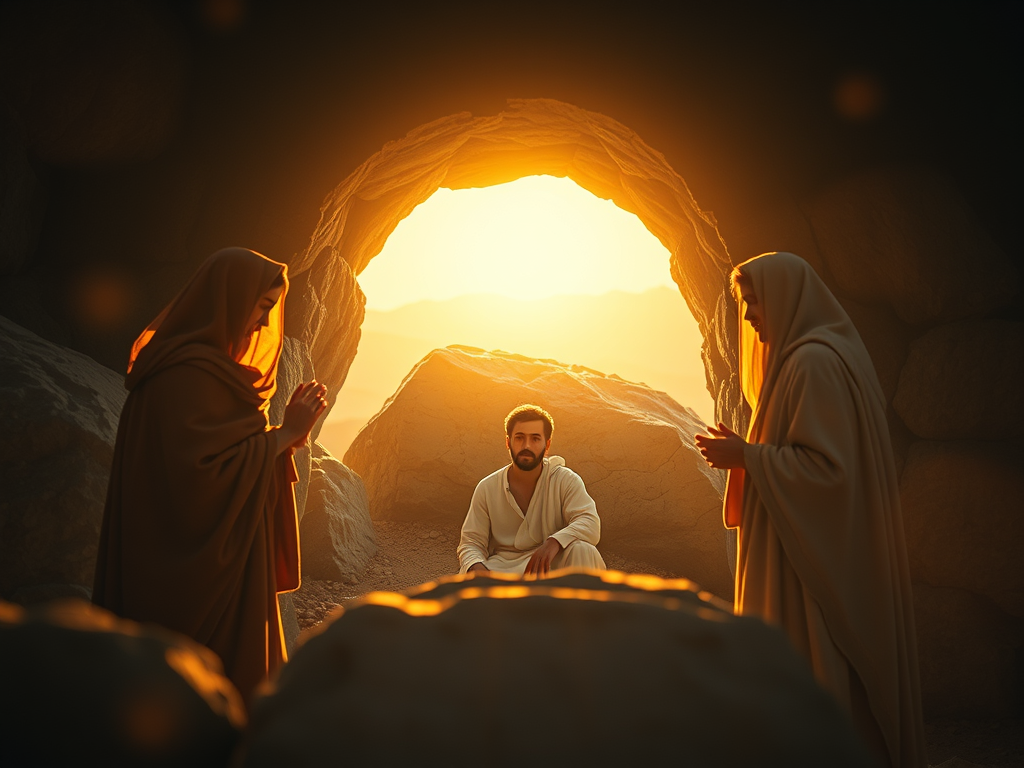
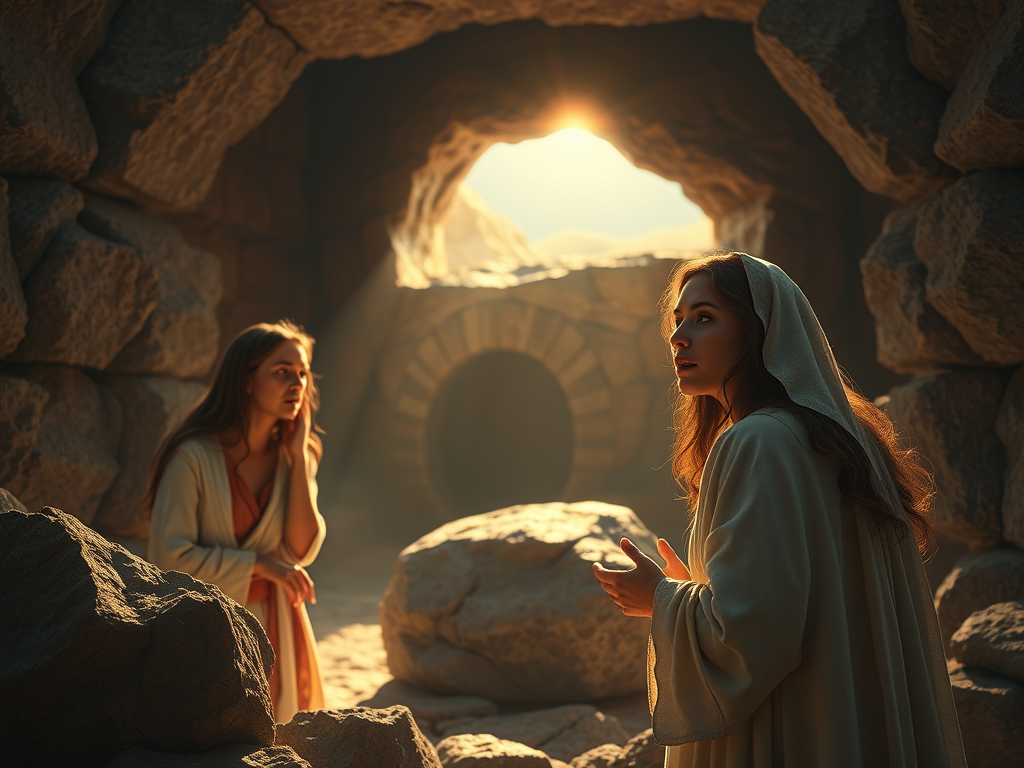
1 But at daybreak on the first day of the week they took the spices they had prepared and went to the tomb.

2

They found the stone rolled away from the tomb;

3

but when they entered, they did not find the body of the Lord Jesus.

4

While they were puzzling over this, behold, two men in dazzling garments appeared to them.

5

They were terrified and bowed their faces to the ground. They said to them, “Why do you seek the living one among the dead?

6

He is not here, but he has been raised. 2 Remember what he said to you while he was still in Galilee,

7

that the Son of Man must be handed over to sinners and be crucified, and rise on the third day.”

8

And they remembered his words.

9

3 Then they returned from the tomb and announced all these things to the eleven and to all the others.

10

The women were Mary Magdalene, Joanna, and Mary the mother of James; the others who accompanied them also told this to the apostles,

11

but their story seemed like nonsense and they did not believe them.

12

4 But Peter got up and ran to the tomb, bent down, and saw the burial cloths alone; then he went home amazed at what had happened.

13

5 6 Now that very day two of them were going to a village seven miles from Jerusalem called Emmaus,

14

and they were conversing about all the things that had occurred.

15

And it happened that while they were conversing and debating, Jesus himself drew near and walked with them,

16

7 but their eyes were prevented from recognizing him.

17

He asked them, “What are you discussing as you walk along?” They stopped, looking downcast.

18

One of them, named Cleopas, said to him in reply, “Are you the only visitor to Jerusalem who does not know of the things that have taken place there in these days?”

19

And he replied to them, “What sort of things?” They said to him, “The things that happened to Jesus the Nazarene, who was a prophet mighty in deed and word before God and all the people,

20

how our chief priests and rulers both handed him over to a sentence of death and crucified him.

21

But we were hoping that he would be the one to redeem Israel; and besides all this, it is now the third day since this took place.

22

Some women from our group, however, have astounded us: they were at the tomb early in the morning

23

and did not find his body; they came back and reported that they had indeed seen a vision of angels who announced that he was alive.

24

Then some of those with us went to the tomb and found things just as the women had described, but him they did not see.”

25

And he said to them, “Oh, how foolish you are! How slow of heart to believe all that the prophets spoke!

26

Was it not necessary that the Messiah should suffer 8 these things and enter into his glory?”

27

Then beginning with Moses and all the prophets, he interpreted to them what referred to him in all the scriptures.

28

As they approached the village to which they were going, he gave the impression that he was going on farther.

29

But they urged him, “Stay with us, for it is nearly evening and the day is almost over.” So he went in to stay with them.

30

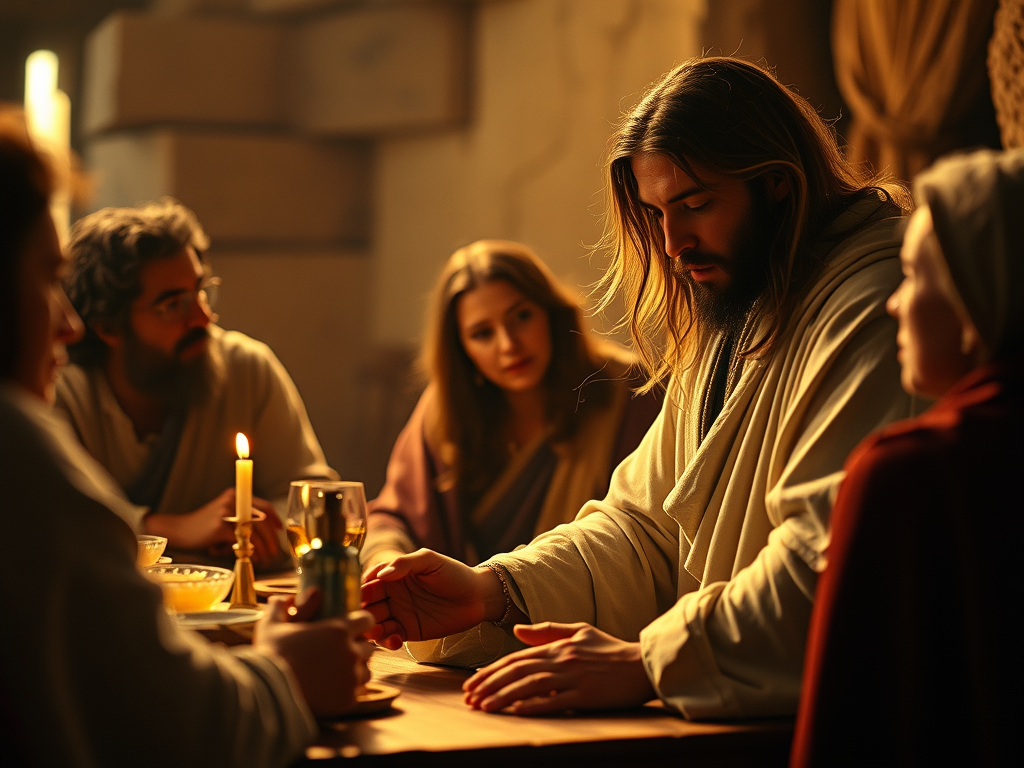
And it happened that, while he was with them at table, he took bread, said the blessing, broke it, and gave it to them.

31

With that their eyes were opened and they recognized him, but he vanished from their sight.

32

Then they said to each other, “Were not our hearts burning (within us) while he spoke to us on the way and opened the scriptures to us?”

33

So they set out at once and returned to Jerusalem where they found gathered together the eleven and those with them

34

who were saying, “The Lord has truly been raised and has appeared to Simon!”

35

Then the two recounted what had taken place on the way and how he was made known to them in the breaking of the bread.

36

9 While they were still speaking about this, he stood in their midst and said to them, “Peace be with you.”

37

But they were startled and terrified and thought that they were seeing a ghost.

38

Then he said to them, “Why are you troubled? And why do questions arise in your hearts?

39

10 Look at my hands and my feet, that it is I myself. Touch me and see, because a ghost does not have flesh and bones as you can see I have.”

40

And as he said this, he showed them his hands and his feet.

41

While they were still incredulous for joy and were amazed, he asked them, “Have you anything here to eat?”

42

They gave him a piece of baked fish;

43

he took it and ate it in front of them.

44

He said to them, “These are my words that I spoke to you while I was still with you, that everything written about me in the law of Moses and in the prophets and psalms must be fulfilled.”

45

Then he opened their minds to understand the scriptures.

46

11 And he said to them, “Thus it is written that the Messiah would suffer and rise from the dead on the third day

47

and that repentance, for the forgiveness of sins, would be preached in his name to all the nations, beginning from Jerusalem.

48

You are witnesses of these things.

49

And (behold) I am sending the promise of my Father 12 upon you; but stay in the city until you are clothed with power from on high.”

50

13 Then he led them (out) as far as Bethany, raised his hands, and blessed them.

51

As he blessed them he parted from them and was taken up to heaven.

52

They did him homage and then returned to Jerusalem with great joy,

53

and they were continually in the temple praising God. 14

1 [1-53] The resurrection narrative in Luke consists of five sec tions: (1) the women at the empty tomb (⇒ Luke 23:56b-⇒ 24:12); (2) the appearance to the two disciples on the way to Emmaus (⇒ Luke 24:13-35); (3) the appearance to the disciples in Jerusalem (⇒ Luke 24:36-43); (4) Jesus’ final instructions (⇒ Luke 24:44-49); (5) the ascension (⇒ Luke 24:50-53). In Luke, all the resurrection appearances take place in and around Jerusalem; moreover, they are all recounted as having taken place on Easter Sunday. A consistent theme throughout the narrative is that the suffering, death, and resurrection of Jesus were accomplished in fulfillment of Old Testament promises and of Jewish hopes (⇒ Luke 24:19a, ⇒ 21, ⇒ 26-27, ⇒ 44, ⇒ 46). In his second volume, Acts, Luke will argue that Christianity is the fulfillment of the hopes of Pharisaic Judaism and its logical development (see ⇒ Acts 24:10-21).
2 [6] He is not here, but he has been raised: this part of the verse is omitted in important representatives of the Western text tradition, but its presence in other text types and the slight difference in wording from ⇒ Matthew 28:6 and ⇒ Mark 16:6 argue for its retention. 
3 [9] The women in this gospel do not flee from the tomb and tell no one, as in ⇒ Mark 16:8 but return and tell the disciples about their experience. The initial reaction to the testimony of the women is disbelief (⇒ Luke 24:11).
4 [12] This verse is missing from the Western textual tradition but is found in the best and oldest manuscripts of other text types.
5 [13-35] This episode focuses on the interpretation of scripture by the risen Jesus and the recognition of him in the breaking of the bread. The references to the quotations of scripture and explanation of it (⇒ Luke 24:25-27), the kerygmatic proclamation (⇒ Luke 24:34), and the liturgical gesture (⇒ Luke 24:30) suggest that the episode is primarily catechetical and liturgical rather than apologetic.
6 [13] Seven miles: literally, “sixty stades.” A stade was 607 feet. Some manuscripts read “160 stades” or more than eighteen miles. The exact location of Emmaus is disputed.
7 [16] A consistent feature of the resurrection stories is that the risen Jesus was different and initially unrecognizable (⇒ Luke 24:37; ⇒ Mark 16:12; ⇒ John 20:14; ⇒ 21:4).
8 [26] That the Messiah should suffer . . . : Luke is the only New Testament writer to speak explicitly of a suffering Messiah (⇒ Luke 24:26, ⇒ 46; ⇒ Acts 3:18; ⇒ 17:3; ⇒ 26:23). The idea of a suffering Messiah is not found in the Old Testament or in other Jewish literature prior to the New Testament period, although the idea is hinted at in ⇒ Mark 8:31-33. See the notes on ⇒ Matthew 26:63 and ⇒ 26:67-68.
9 [36-43,44-49] The Gospel of Luke, like each of the other gospels (⇒ Matthew 28:16-20; ⇒ Mark 16:14-15; ⇒ John 20:19-23), focuses on an important appearance of Jesus to the Twelve in which they are commissioned for their future ministry. As in ⇒ Luke 24:6, ⇒ 12, so in ⇒ Luke 24:36, ⇒ 40 there are omissions in the Western text.
10 [39-42] The apologetic purpose of this story is evident in the concern with the physical details and the report that Jesus ate food.
11 [46] See the note on ⇒ Luke 24:26.
12 [49] The promise of my Father: i.e., the gift of the holy Spirit.
13 [50-53] Luke brings his story about the time of Jesus to a close with the report of the ascension. He will also begin the story of the time of the church with a recounting of the ascension. In the gospel, Luke recounts the ascension of Jesus on Easter Sunday night, thereby closely associating it with the resurrection. In ⇒ Acts 1:3, ⇒ 9-11; ⇒ 13:31 he historicizes the ascension by speaking of a forty-day period between the resurrection and the ascension. The Western text omits some phrases in ⇒ Luke 24:51, ⇒ 52 perhaps to avoid any chronological conflict with Acts 1 about the time of the ascension.
14 [53] The Gospel of Luke ends as it began (⇒ Luke 1:9), in the Jerusalem temple.

The Bible – New Testament

Saint Luke

Index

1. 2. 3. 4. 5. 6. 7. 8. 9.

10. 11. 12. 13. 14. 15. 16.

17. 18. 19. 2021. 22. 23. 24. 

The Bible – New Testament

Saint John

Index

1. 2. 3. 4. 5. 6. 7. 8. 9. 10. 11. 12.
13. 14. 15. 16. 17. 18. 19. 20. 21.

Chapter 18

1

1 2 When he had said this, Jesus went out with his disciples across the Kidron valley to where there was a garden, into which he and his disciples entered.

2

Judas his betrayer also knew the place, because Jesus had often met there with his disciples.

3

So Judas got a band of soldiers 3 and guards from the chief priests and the Pharisees and went there with lanterns, torches, and weapons.

4

Jesus, knowing everything that was going to happen to him, went out and said to them, “Whom are you looking for?”

5

They answered him, “Jesus the Nazorean.” 4 He said to them, “I AM.” Judas his betrayer was also with them.

6

When he said to them, “I AM,” they turned away and fell to the ground.

7

So he again asked them, “Whom are you looking for?” They said, “Jesus the Nazorean.”

8

Jesus answered, “I told you that I AM. So if you are looking for me, let these men go.”

9

5 This was to fulfill what he had said, “I have not lost any of those you gave me.”

10

Then Simon Peter, who had a sword, drew it, struck the high priest’s slave, and cut off his right ear. The slave’s name was Malchus. 6

11

Jesus said to Peter, “Put your sword into its scabbard. Shall I not drink the cup 7 that the Father gave me?”

12

So the band of soldiers, the tribune, and the Jewish guards seized Jesus, bound him,

13

and brought him to Annas 8 first. He was the father-in-law of Caiaphas, who was high priest that year.

14

It was Caiaphas who had counseled the Jews that it was better that one man should die rather than the people.

15

Simon Peter and another disciple 9 followed Jesus. Now the other disciple was known to the high priest, and he entered the courtyard of the high priest with Jesus.

16

But Peter stood at the gate outside. So the other disciple, the acquaintance of the high priest, went out and spoke to the gatekeeper and brought Peter in.

17

Then the maid who was the gatekeeper said to Peter, “You are not one of this man’s disciples, are you?” He said, “I am not.”

18

Now the slaves and the guards were standing around a charcoal fire that they had made, because it was cold, and were warming themselves. Peter was also standing there keeping warm.

19

The high priest questioned Jesus about his disciples and about his doctrine.

20

Jesus answered him, “I have spoken publicly to the world. I have always taught in a synagogue or in the temple area 10 where all the Jews gather, and in secret I have said nothing.

21

Why ask me? Ask those who heard me what I said to them. They know what I said.”

22

When he had said this, one of the temple guards standing there struck Jesus and said, “Is this the way you answer the high priest?”

23

Jesus answered him, “If I have spoken wrongly, testify to the wrong; but if I have spoken rightly, why do you strike me?”

24

Then Annas sent him bound to Caiaphas 11 the high priest.

25

Now Simon Peter was standing there keeping warm. And they said to him, “You are not one of his disciples, are you?” He denied it and said, “I am not.”

26

One of the slaves of the high priest, a relative of the one whose ear Peter had cut off, said, “Didn’t I see you in the garden with him?”

27

Again Peter denied it. And immediately the cock crowed. 12

28

Then they brought Jesus from Caiaphas to the praetorium. 13 It was morning. And they themselves did not enter the praetorium, in order not to be defiled so that they could eat the Passover.

29

So Pilate came out to them and said, “What charge do you bring (against) this man?”

30

They answered and said to him, “If he were not a criminal, we would not have handed him over to you.”

31

At this, Pilate said to them, “Take him yourselves, and judge him according to your law.” The Jews answered him, “We do not have the right to execute anyone,” 14

32

15 in order that the word of Jesus might be fulfilled that he said indicating the kind of death he would die.

33

So Pilate went back into the praetorium and summoned Jesus and said to him, “Are you the King of the Jews?”

34

Jesus answered, “Do you say this on your own or have others told you about me?”

35

Pilate answered, “I am not a Jew, am I? Your own nation and the chief priests handed you over to me. What have you done?”

36

Jesus answered, “My kingdom does not belong to this world. If my kingdom did belong to this world, my attendants (would) be fighting to keep me from being handed over to the Jews. But as it is, my kingdom is not here.”

37

So Pilate said to him, “Then you are a king?” Jesus answered, “You say I am a king. 16 For this I was born and for this I came into the world, to testify to the truth. Everyone who belongs to the truth listens to my voice.”

38

Pilate said to him, “What is truth?” When he had said this, he again went out to the Jews and said to them, “I find no guilt in him.

39

But you have a custom that I release one prisoner to you at Passover. 17 Do you want me to release to you the King of the Jews?”

40

They cried out again, “Not this one but Barabbas!” 18 Now Barabbas was a revolutionary.

1 [1-14] John does not mention the agony in the garden and the kiss of Judas, nor does he identify the place as Gethsemane or the Mount of Olives.
2 [1] Jesus went out: see ⇒ John 14:31 where it seems he is leaving the supper room. Kidron valley: literally, “the winter-flowing Kidron”; this wadi has water only during the winter rains.
3 [3] Band of soldiers: seems to refer to Roman troops, either the full cohort of 600 men (1/10 of a legion), or more likely the maniple of 200 under their tribune (⇒ John 18:12). In this case, John is hinting at Roman collusion in the action against Jesus before he was brought to Pilate. The lanterns and torches may be symbolic of the hour of darkness.
4 [5] Nazorean: the form found in ⇒ Matthew 26:71 (see the note on ⇒ Matthew 2:23) is here used, not Nazarene of Mark. I AM: or “I am he,” but probably intended by the evangelist as an expression of divinity (cf their appropriate response in ⇒ John 18:6); see the note on ⇒ John 8:24. John sets the confusion of the arresting party against the background of Jesus’ divine majesty.
5 [9] The citation may refer to ⇒ John 6:39; ⇒ 10:28; or ⇒ John 17:12.
6 [10] Only John gives the names of the two antagonists; both John and Luke mention the right ear.
7 [11] The theme of the cup is found in the synoptic account of the agony (⇒ Mark 14:36 and parallels).
8 [13] Annas: only John mentions an inquiry before Annas; cf ⇒ John 18:16, ⇒ 19-24; see the note on ⇒ Luke 3:2. It is unlikely that this nighttime interrogation before Annas is the same as the trial before Caiaphas placed by Matthew and Mark at night and by Luke in the morning.
9 [15-16] Another disciple . . . the other disciple: see the note on ⇒ John 13:23.
10 [20] I have always taught . . . in the temple area: cf ⇒ Mark 14:49 for a similar statement.
11 [24] Caiaphas: see ⇒ Matthew 26:3, ⇒ 57; ⇒ Luke 3:2; and the notes there. John may leave room here for the trial before Caiaphas described in the synoptic gospels.
12 [27] Cockcrow was the third Roman division of the night, lasting from midnight to 3 A.M.
13 [28] Praetorium: see the note on ⇒ Matthew 27:27. Morning: literally, “the early hour,” or fourth Roman division of the night, 3 to 6 A.M. The Passover: the synoptic gospels give the impression that the Thursday night supper was the Passover meal (⇒ Mark 14:12); for John that meal is still to be eaten Friday night.
14 [31] We do not have the right to execute anyone: only John gives this reason for their bringing Jesus to Pilate. Jewish sources are not clear on the competence of the Sanhedrin at this period to sentence and to execute for political crimes.
15 [32] The Jewish punishment for blasphemy was stoning (⇒ Lev 24:16). In coming to the Romans to ensure that Jesus would be crucified, the Jewish authorities fulfilled his prophecy that he would be exalted (⇒ John 3:14; ⇒ 12:32-33). There is some historical evidence, however, for Jews crucifying Jews.
16 [37] You say I am a king: see ⇒ Matthew 26:64 for a similar response to the high priest. It is at best a reluctant affirmative.
17 [39] See the note on ⇒ Matthew 27:15.
18 [40] Barabbas: see the note on ⇒ Matthew 27:16-17. Revolutionary: a guerrilla warrior fighting for nationalistic aims, though the term can also denote a robber. See the note on ⇒ Matthew 27:38.

The Bible – New Testament

Saint John

Index 

1. 2. 3. 4. 5. 6. 7. 8.

9. 10. 11. 12. 13. 14. 15.

16. 17. 18. 19. 20. 21.

The Bible – New Testament

Saint John

Index

1. 2. 3. 4. 5. 6. 7. 8. 9. 10. 11. 12.
13. 14. 15. 16. 17. 18. 19. 20. 21.

Chapter 13

1

1 2 3 Before the feast of Passover, Jesus knew that his hour had come to pass from this world to the Father. He loved his own in the world and he loved them to the end.

2

The devil had already induced 4 Judas, son of Simon the Iscariot, to hand him over. So, during supper,

3

fully aware that the Father had put everything into his power and that he had come from God and was returning to God,

4

he rose from supper and took off his outer garments. He took a towel and tied it around his waist.

5

5 Then he poured water into a basin and began to wash the disciples’ feet and dry them with the towel around his waist.

6

He came to Simon Peter, who said to him, “Master, are you going to wash my feet?”

7

Jesus answered and said to him, “What I am doing, you do not understand now, but you will understand later.”

8

Peter said to him, “You will never wash my feet.” Jesus answered him, “Unless I wash you, you will have no inheritance with me.”

9

Simon Peter said to him, “Master, then not only my feet, but my hands and head as well.”

10

Jesus said to him, “Whoever has bathed 6 has no need except to have his feet washed, for he is clean all over; so you are clean, but not all.”

11

For he knew who would betray him; for this reason, he said, “Not all of you are clean.”

12

So when he had washed their feet (and) put his garments back on and reclined at table again, he said to them, “Do you realize what I have done for you?

13

You call me ‘teacher’ and ‘master,’ and rightly so, for indeed I am.

14

If I, therefore, the master and teacher, have washed your feet, you ought to wash one another’s feet.

15

I have given you a model to follow, so that as I have done for you, you should also do.

16

Amen, amen, I say to you, no slave is greater than his master nor any messenger 7 greater than the one who sent him.

17

If you understand this, blessed are you if you do it.

18

I am not speaking of all of you. I know those whom I have chosen. But so that the scripture might be fulfilled, ‘The one who ate my food has raised his heel against me.’

19

From now on I am telling you before it happens, so that when it happens you may believe that I AM.

20

Amen, amen, I say to you, whoever receives the one I send receives me, and whoever receives me receives the one who sent me.”

21

When he had said this, Jesus was deeply troubled and testified, “Amen, amen, I say to you, one of you will betray me.”

22

The disciples looked at one another, at a loss as to whom he meant.

23

One of his disciples, the one whom Jesus loved, 8 was reclining at Jesus’ side.

24

So Simon Peter nodded to him to find out whom he meant.

25

He leaned back against Jesus’ chest and said to him, “Master, who is it?”

26

Jesus answered, “It is the one to whom I hand the morsel 9 after I have dipped it.” So he dipped the morsel and (took it and) handed it to Judas, son of Simon the Iscariot.

27

After he took the morsel, Satan entered him. So Jesus said to him, “What you are going to do, do quickly.”

28

(Now) none of those reclining at table realized why he said this to him.

29

Some thought that since Judas kept the money bag, Jesus had told him, “Buy what we need for the feast,” or to give something to the poor.

30

So he took the morsel and left at once. And it was night.

31

10 11 When he had left, Jesus said, “Now is the Son of Man glorified, and God is glorified in him.

32

(If God is glorified in him,) God will also glorify him in himself, and he will glorify him at once.

33

My children, I will be with you only a little while longer. You will look for me, and as I told the Jews, ‘Where I go you cannot come,’ so now I say it to you.

34

I give you a new commandment: 12 love one another. As I have loved you, so you also should love one another.

35

This is how all will know that you are my disciples, if you have love for one another.”

36

Simon Peter said to him, “Master, where are you going?” Jesus answered (him), “Where I am going, you cannot follow me now, though you will follow later.”

37

Peter said to him, “Master, why can’t I follow you now? I will lay down my life for you.”

38

Jesus answered, “Will you lay down your life for me? Amen, amen, I say to you, the cock will not crow before you deny me three times.”

1 [⇒ 13:1-⇒ 19:42] The Book of Glory. There is a major break here; the word “sign” is used again only in ⇒ John 20:30. In this phase of Jesus’ return to the Father, the discourses (John 13-17) precede the traditional narrative of the passion (John 18-20) to interpret them for the Christian reader. This is the only extended example of esoteric teaching of disciples in John.
2 [1-20] Washing of the disciples’ feet. This episode occurs in John at the place of the narration of the institution of the Eucharist in the synoptics. It may be a dramatization of ⇒ Luke 22:27 – “I am your servant.” It is presented as a “model” (“pattern”) of the crucifixion. It symbolizes cleansing from sin by sacrificial death.
3 [1] Before the feast of Passover: this would be Thursday evening, before the day of preparation; in the synoptics, the Last Supper is a Passover meal taking place, in John’s chronology, on Friday evening. To the end: or, “completely.”
4 [2] Induced: literally, “The devil put into the heart that Judas should hand him over.”
5 [5] The act of washing another’s feet was one that could not be required of the lowliest Jewish slave. It is an allusion to the humiliating death of the crucifixion.
6 [10] Bathed: many have suggested that this passage is a symbolic reference to baptism. The Greek root involved is used in baptismal contexts in ⇒ 1 Cor 6:11; ⇒ Eph 5:26; ⇒ Titus 3:5; ⇒ Hebrews 10:22.
7 [16] Messenger: the Greek has apostolos, the only occurrence of the term in John. It is not used in the technical sense here.
8 [23] The one whom Jesus loved: also mentioned in ⇒ John 19:26; ⇒ 20:2; ⇒ 21:7. A disciple, called “another disciple” or “the other disciple,” is mentioned in ⇒ John 18:15 and ⇒ John 20:2; in the latter reference he is identified with the disciple whom Jesus loved. There is also an unnamed disciple in ⇒ John 1:35-40; see the note on ⇒ John 1:37.
9 [26] Morsel: probably the bitter herb dipped in salt water.
10 [⇒ 13:31-⇒ 17:26] Two farewell discourses and a prayer. These seem to be Johannine compositions, including sayings of Jesus at the Last Supper and on other occasions, modeled on similar farewell discourses in Greek literature and the Old Testament (of Moses, Joshua, David).
11 [31-38] Introduction: departure and return. Terms of coming and going predominate. These verses form an introduction to the last discourse of Jesus, which extends through John 14-17. In it John has collected Jesus’ words to his own (⇒ John 13:1). There are indications that several speeches have been fused together, e.g., in ⇒ John 14:31 and ⇒ John 17:1.
12 [34] I give you a new commandment: this puts Jesus on a par with Yahweh. The commandment itself is not new; cf ⇒ Lev 19:18 and the note there.

The Bible – New Testament

Saint John

Index 

1. 2. 3. 4. 5. 6. 7. 8.

9. 10. 11. 12. 13. 14. 15.

16. 17. 18. 19. 20. 21.

Saint Luke – Chapter 1

The Bible – New Testament Saint Luke Index 1. 2. 3. 4. 5. 6. 7. 8. 9. 10. 11. 12. 13. 14. 15. 16. 17. 18. 19. 20. 21. 22. 23. 24.  Chapter 1 1 1 Since many have undertaken to compile a narrative of the events that have been fulfilled among us, 2 just as those who were eyewitnesses from the… Continue reading Saint Luke – Chapter 1

Published
Categorised as SAINT LUKE

Hebrews – Chapter 10

The Bible – New Testament Hebrews Index 1. 2. 3. 4. 5. 6. 7. 8. 9. 10. 11. 12. 13. Chapter 10 1 1 Since the law has only a shadow of the good things to come, 2 and not the very image of them, it can never make perfect those who come to worship by the same… Continue reading Hebrews – Chapter 10

Matthew 

1. 2. 3. 4. 5. 6. 7. 8. 9. 10. 11.
12. 13. 14. 15. 16. 17. 18. 19. 20
21. 22. 23. 24. 25. 26. 27. 28.

Mark

Sain Mark

1. 2. 3. 4. 5. 6. 7. 8. 9.
10. 11. 12. 13. 14. 15. 16.

Luke 

1. 2. 3. 4. 5. 6. 7. 8. 9.
10. 11. 12. 13. 14. 15. 16.
17. 18. 19. 2021. 22. 23. 24. 

John

1. 2. 3. 4. 5. 6. 7. 8. 9. 10. 11. 12.
13. 14. 15. 16. 17. 18. 19. 20. 21.

OLD TESTAMENT

THE GOSPELS

NEW TESTAMENT

The Bible – New Testament

Saint Mark

Index

1. 2. 3. 4. 5. 6. 7. 8. 9.
10. 11. 12. 13. 14. 15. 16.

Chapter 7

1

1 Now when the Pharisees with some scribes who had come from Jerusalem gathered around him,

2

they observed that some of his disciples ate their meals with unclean, that is, unwashed, hands.

3

(For the Pharisees and, in fact, all Jews, do not eat without carefully washing their hands, 2 keeping the tradition of the elders.

4

And on coming from the marketplace they do not eat without purifying themselves. And there are many other things that they have traditionally observed, the purification of cups and jugs and kettles (and beds).)

5

So the Pharisees and scribes questioned him, “Why do your disciples not follow the tradition of the elders 3 but instead eat a meal with unclean hands?”

6

He responded, “Well did Isaiah prophesy about you hypocrites, as it is written: ‘This people honors me with their lips, but their hearts are far from me;

7

In vain do they worship me, teaching as doctrines human precepts.’

8

You disregard God’s commandment but cling to human tradition.”

9

He went on to say, “How well you have set aside the commandment of God in order to uphold your tradition!

10

For Moses said, ‘Honor your father and your mother,’ and ‘Whoever curses father or mother shall die.’

11

Yet you say, ‘If a person says to father or mother, “Any support you might have had from me is qorban”‘ 4 (meaning, dedicated to God),

12

you allow him to do nothing more for his father or mother.

13

You nullify the word of God in favor of your tradition that you have handed on. And you do many such things.”

14

He summoned the crowd again and said to them, “Hear me, all of you, and understand.

15

Nothing that enters one from outside can defile that person; but the things that come out from within are what defile.”

16

5

17

6 When he got home away from the crowd his disciples questioned him about the parable.

18

He said to them, “Are even you likewise without understanding? Do you not realize that everything that goes into a person from outside cannot defile,

19

7 since it enters not the heart but the stomach and passes out into the latrine?” (Thus he declared all foods clean.)

20

“But what comes out of a person, that is what defiles.

21

From within people, from their hearts, come evil thoughts, unchastity, theft, murder,

22

adultery, greed, malice, deceit, licentiousness, envy, blasphemy, arrogance, folly.

23

All these evils come from within and they defile.”

24

From that place he went off to the district of Tyre. 8 He entered a house and wanted no one to know about it, but he could not escape notice.

25

Soon a woman whose daughter had an unclean spirit heard about him. She came and fell at his feet.

26

The woman was a Greek, a Syrophoenician by birth, and she begged him to drive the demon out of her daughter.

27

He said to her, “Let the children be fed first. 9 For it is not right to take the food of the children and throw it to the dogs.”

28

She replied and said to him, “Lord, even the dogs under the table eat the children’s scraps.”

29

Then he said to her, “For saying this, you may go. The demon has gone out of your daughter.”

30

When the woman went home, she found the child lying in bed and the demon gone.

31

Again he left the district of Tyre and went by way of Sidon to the Sea of Galilee, into the district of the Decapolis.

32

And people brought to him a deaf man who had a speech impediment and begged him to lay his hand on him.

33

He took him off by himself away from the crowd. He put his finger into the man’s ears and, spitting, touched his tongue;

34

then he looked up to heaven and groaned, and said to him, “Ephphatha!” (that is, “Be opened!”)

35

And (immediately) the man’s ears were opened, his speech impediment was removed, and he spoke plainly.

36

10 He ordered them not to tell anyone. But the more he ordered them not to, the more they proclaimed it.

37

They were exceedingly astonished and they said, “He has done all things well. He makes the deaf hear and (the) mute speak.”


1 [1-23] See the note on ⇒ Matthew 15:1-20. Against the Pharisees’ narrow, legalistic, and external practices of piety in matters of purification (⇒ Mark 7:2-5), external worship (⇒ Mark 7:6-7), and observance of commandments, Jesus sets in opposition the true moral intent of the divine law (⇒ Mark 7:8-13). But he goes beyond contrasting the law and Pharisaic interpretation of it. The parable of ⇒ Mark 7:14-15 in effect sets aside the law itself in respect to clean and unclean food. He thereby opens the way for unity between Jew and Gentile in the kingdom of God, intimated by Jesus’ departure for pagan territory beyond Galilee. For similar contrast see ⇒ Mark 2:1-⇒ 3:6; ⇒ 3:20-35; ⇒ 6:1-6.
2 [3] Carefully washing their hands: refers to ritual purification.
3 [5] Tradition of the elders: the body of detailed, unwritten, human laws regarded by the scribes and Pharisees to have the same binding force as that of the Mosaic law; cf ⇒ Gal 1:14.
4 [11] Qorban: a formula for a gift to God, dedicating the offering to the temple, so that the giver might continue to use it for himself but not give it to others, even needy parents.
5 [16] ⇒ Mark 7:16, “Anyone who has ears to hear ought to hear,” is omitted because it is lacking in some of the best Greek manuscripts and was probably transferred here by scribes from ⇒ Mark 4:9, ⇒ 23.
6 [17] Away from the crowd . . . the parable: in this context of privacy the term parable refers to something hidden, about to be revealed to the disciples; cf ⇒ Mark 4:10-11.34. Jesus sets the Mosaic food laws in the context of the kingdom of God where they are abrogated, and he declares moral defilement the only cause of uncleanness.
7 [19] (Thus he declared all foods clean): if this bold declaration goes back to Jesus, its force was not realized among Jewish Christians in the early church; cf ⇒ Acts 10:1-⇒ 11:18.
8 [24-37] The withdrawal of Jesus to the district of Tyre may have been for a respite (⇒ Mark 7:24), but he soon moved onward to Sidon and, by way of the Sea of Galilee, to the Decapolis. These districts provided a Gentile setting for the extension of his ministry of healing because the people there acknowledged his power (⇒ Mark 7:29, ⇒ 37). The actions attributed to Jesus (⇒ Mark 7:33-35) were also used by healers of the time.
9 [27-28] The figure of a household in which children at table are fed first and then their leftover food is given to the dogs under the table is used effectively to acknowledge the prior claim of the Jews to the ministry of Jesus; however, Jesus accedes to the Gentile woman’s plea for the cure of her afflicted daughter because of her faith.
10 [36] The more they proclaimed it: the same verb proclaim attributed here to the crowd in relation to the miracles of Jesus is elsewhere used in Mark for the preaching of the gospel on the part of Jesus, of his disciples, and of the Christian community (⇒ Mark 1:14; ⇒ 13:10; ⇒ 14:9). Implied in the action of the crowd is a recognition of the salvific mission of Jesus; see the note on ⇒ Matthew 11:5-6.

The Bible – New Testament

Saint Mark

Index

1. 2. 3. 4. 5. 6. 7. 8. 9.
10. 11. 12. 13. 14. 15. 16.

The Bible – New Testament

Saint Mark

Index

1. 2. 3. 4. 5. 6. 7. 8. 9.
10. 11. 12. 13. 14. 15. 16.

Chapter 6

1

He departed from there and came to his native place, 1 accompanied by his disciples.

2

2 When the sabbath came he began to teach in the synagogue, and many who heard him were astonished. They said, “Where did this man get all this? What kind of wisdom has been given him? What mighty deeds are wrought by his hands!

3

Is he not the carpenter, 3 the son of Mary, and the brother of James and Joses and Judas and Simon? And are not his sisters here with us?” And they took offense at him.

4

4 Jesus said to them, “A prophet is not without honor except in his native place and among his own kin and in his own house.”

5

So he was not able to perform any mighty deed there, 5 apart from curing a few sick people by laying his hands on them.

6

He was amazed at their lack of faith. He went around to the villages in the vicinity teaching.

7

He summoned the Twelve 6 and began to send them out two by two and gave them authority over unclean spirits.

8

7 He instructed them to take nothing for the journey but a walking stick – no food, no sack, no money in their belts.

9

They were, however, to wear sandals but not a second tunic.

10

8 He said to them, “Wherever you enter a house, stay there until you leave from there.

11

Whatever place does not welcome you or listen to you, leave there and shake the dust off your feet in testimony against them.”

12

So they went off and preached repentance.

13

9 They drove out many demons, and they anointed with oil many who were sick and cured them.

14

10 King Herod 11 heard about it, for his fame had become widespread, and people were saying, “John the Baptist has been raised from the dead; that is why mighty powers are at work in him.”

15

Others were saying, “He is Elijah”; still others, “He is a prophet like any of the prophets.”

16

But when Herod learned of it, he said, “It is John whom I beheaded. He has been raised up.”

17

12 Herod was the one who had John arrested and bound in prison on account of Herodias, the wife of his brother Philip, whom he had married.

18

John had said to Herod, “It is not lawful for you to have your brother’s wife.”

19

Herodias 13 harbored a grudge against him and wanted to kill him but was unable to do so.

20

Herod feared John, knowing him to be a righteous and holy man, and kept him in custody. When he heard him speak he was very much perplexed, yet he liked to listen to him.

21

She had an opportunity one day when Herod, on his birthday, gave a banquet for his courtiers, his military officers, and the leading men of Galilee.

22

Herodias’s own daughter came in and performed a dance that delighted Herod and his guests. The king said to the girl, “Ask of me whatever you wish and I will grant it to you.”

23

He even swore (many things) to her, “I will grant you whatever you ask of me, even to half of my kingdom.”

24

She went out and said to her mother, “What shall I ask for?” She replied, “The head of John the Baptist.”

25

The girl hurried back to the king’s presence and made her request, “I want you to give me at once on a platter the head of John the Baptist.”

26

The king was deeply distressed, but because of his oaths and the guests he did not wish to break his word to her.

27

So he promptly dispatched an executioner with orders to bring back his head. He went off and beheaded him in the prison.

28

He brought in the head on a platter and gave it to the girl. The girl in turn gave it to her mother.

29

When his disciples heard about it, they came and took his body and laid it in a tomb.

30

The apostles 14 gathered together with Jesus and reported all they had done and taught.

31

15 He said to them, “Come away by yourselves to a deserted place and rest a while.” People were coming and going in great numbers, and they had no opportunity even to eat.

32

So they went off in the boat by themselves to a deserted place.

33

People saw them leaving and many came to know about it. They hastened there on foot from all the towns and arrived at the place before them.

34

When he disembarked and saw the vast crowd, his heart was moved with pity for them, for they were like sheep without a shepherd; and he began to teach them many things.

35

16 By now it was already late and his disciples approached him and said, “This is a deserted place and it is already very late.

36

Dismiss them so that they can go to the surrounding farms and villages and buy themselves something to eat.”

37

He said to them in reply, “Give them some food yourselves.” But they said to him, “Are we to buy two hundred days’ wages worth of food and give it to them to eat?”

38

He asked them, “How many loaves do you have? Go and see.” And when they had found out they said, “Five loaves and two fish.”

39

So he gave orders to have them sit down in groups on the green grass.

40

17 The people took their places in rows by hundreds and by fifties.

41

Then, taking the five loaves and the two fish and looking up to heaven, he said the blessing, broke the loaves, and gave them to (his) disciples to set before the people; he also divided the two fish among them all. 18

42

They all ate and were satisfied.

43

And they picked up twelve wicker baskets full of fragments and what was left of the fish.

44

Those who ate (of the loaves) were five thousand men.

45

19 Then he made his disciples get into the boat and precede him to the other side toward Bethsaida, 20 while he dismissed the crowd.

46

21 And when he had taken leave of them, he went off to the mountain to pray.

47

When it was evening, the boat was far out on the sea and he was alone on shore.

48

Then he saw that they were tossed about while rowing, for the wind was against them. About the fourth watch of the night, he came toward them walking on the sea. 22 He meant to pass by them.

49

But when they saw him walking on the sea, they thought it was a ghost and cried out.

50

23 They had all seen him and were terrified. But at once he spoke with them, “Take courage, it is I, do not be afraid!”

51

He got into the boat with them and the wind died down. They were (completely) astounded.

52

They had not understood the incident of the loaves. 24 On the contrary, their hearts were hardened.

53

After making the crossing, they came to land at Gennesaret and tied up there.

54

As they were leaving the boat, people immediately recognized him.

55

They scurried about the surrounding country and began to bring in the sick on mats to wherever they heard he was.

56

Whatever villages or towns or countryside he entered, they laid the sick in the marketplaces and begged him that they might touch only the tassel on his cloak; and as many as touched it were healed.

 
1 [1] His native place: the Greek word patris here refers to Nazareth (cf ⇒ Mark 1:9; ⇒ Luke 4:16, ⇒ 23-24) though it can also mean native land.
2 [2-6] See the note on ⇒ Matthew 13:54-58.
3 [3] Is he not the carpenter?: no other gospel calls Jesus a carpenter. Some witnesses have “the carpenter’s son,” as in ⇒ Matthew 13:55. Son of Mary: contrary to Jewish custom, which calls a man the son of his father, this expression may reflect Mark’s own faith that God is the Father of Jesus (⇒ Mark 1:1, ⇒ 11; ⇒ 8:38; ⇒ 13:32; ⇒ 14:36). The brother of James . . . Simon: in Semitic usage, the terms “brother,” “sister” are applied not only to children of the same parents, but to nephews, nieces, cousins, half-brothers, and half-sisters; cf ⇒ Genesis 14:16; ⇒ 29:15; ⇒ Lev 10:4. While one cannot suppose that the meaning of a Greek word should be sought in the first place from Semitic usage, the Septuagint often translates the Hebrew ah by the Greek word adelphos, “brother,” as in the cited passages, a fact that may argue for a similar breadth of meaning in some New Testament passages. For instance, there is no doubt that in v 17, “brother” is used of Philip, who was actually the half-brother of Herod Antipas. On the other hand, Mark may have understood the terms literally; see also ⇒ Mark 3:31-32; ⇒ Matthew 12:46; ⇒ 13:55-56; ⇒ Luke 8:19; ⇒ John 7:3, 5. The question of meaning here would not have arisen but for the faith of the church in Mary’s perpetual virginity.
4 [4] A prophet is not without honor except . . . in his own house: a saying that finds parallels in other literatures, especially Jewish and Greek, but without reference to a prophet. Comparing himself to previous Hebrew prophets whom the people rejected, Jesus intimates his own eventual rejection by the nation especially in view of the dishonor his own relatives had shown him (⇒ Mark 3:21) and now his townspeople as well.
5 [5] He was not able to perform any mighty deed there: according to Mark, Jesus’ power could not take effect because of a person’s lack of faith.
6 [7-13] The preparation for the mission of the Twelve is seen in the call (1) of the first disciples to be fishers of men (⇒ Mark 1:16-20), (2) then of the Twelve set apart to be with Jesus and to receive authority to preach and expel demons (⇒ Mark 3:13-19). Now they are given the specific mission to exercise that authority in word and power as representatives of Jesus during the time of their formation.
7 [8-9] In Mark the use of a walking stick (⇒ Mark 6:8) and sandals (⇒ Mark 6:9) is permitted, but not in ⇒ Matthew 10:10 nor in ⇒ Luke 10:4. Mark does not mention any prohibition to visit pagan territory and to enter Samaritan towns. These differences indicate a certain adaptation to conditions in and outside of Palestine and suggest in Mark’s account a later activity in the church. For the rest, Jesus required of his apostles a total dependence on God for food and shelter; cf ⇒ Mark 6:35-44; ⇒ 8:1-9.
8 [10-11] Remaining in the same house as a guest (⇒ Mark 6:10) rather than moving to another offering greater comfort avoided any impression of seeking advantage for oneself and prevented dishonor to one’s host. Shaking the dust off one’s feet served as testimony against those who rejected the call to repentance.
9 [13] Anointed with oil . . . cured them: a common medicinal remedy, but seen here as a vehicle of divine power for healing.
10 [14-16] The various opinions about Jesus anticipate the theme of his identity that reaches its climax in ⇒ Mark 8:27-30.
11 [14] King Herod: see the note on ⇒ Matthew 14:1.
12 [17-29] Similarities are to be noted between Mark’s account of the imprisonment and death of John the Baptist in this pericope, and that of the passion of Jesus (⇒ Mark 15:1-47). Herod and Pilate, each in turn, acknowledges the holiness of life of one over whom he unjustly exercises the power of condemnation and death (⇒ Mark 6:26-27; ⇒ 15:9-10, ⇒ 14-15). The hatred of Herodias toward John parallels that of the Jewish leaders toward Jesus. After the deaths of John and of Jesus, well-disposed persons request the bodies of the victims of Herod and of Pilate in turn to give them respectful burial (⇒ Mark 6:29; ⇒ 15:45-46).
13 [19] Herodias: see the note on ⇒ Matthew 14:3.
14 [30] Apostles: here, and in some manuscripts at ⇒ Mark 3:14, Mark calls apostles (i.e., those sent forth) the Twelve whom Jesus sends as his emissaries, empowering them to preach, to expel demons, and to cure the sick (⇒ Mark 6:13). Only after Pentecost is the title used in the technical sense.
15 [31-34] The withdrawal of Jesus with his disciples to a desert place to rest attracts a great number of people to follow them. Toward this people of the new exodus Jesus is moved with pity; he satisfies their spiritual hunger by teaching them many things, thus gradually showing himself the faithful shepherd of a new Israel; cf ⇒ Numbers 27:17; ⇒ Ezekiel 34:15.
16 [35] See the note on ⇒ Matthew 14:13-21. Compare this section with ⇒ Mark 8:1-9. The various accounts of the multiplication of loaves and fishes, two each in Mark and in Matthew and one each in Luke and in John, indicate the wide interest of the early church in their eucharistic gatherings; see, e.g., ⇒ Mark 6:41; ⇒ 8:6; ⇒ 14:22; and recall also the sign of bread in Exodus 16; ⇒ Deut 8:3-16; ⇒ Psalm 78:24-25; ⇒ 105:40; ⇒ Wisdom 16:20-21.
17 [40] The people . . . in rows by hundreds and by fifties: reminiscent of the groupings of Israelites encamped in the desert (⇒ Exodus 18:21-25) and of the wilderness tradition of the prophets depicting the transformation of the wasteland into pastures where the true shepherd feeds his flock (⇒ Ezekiel 34:25-26) and makes his people beneficiaries of messianic grace.
18 [41] On the language of this verse as eucharistic (cf ⇒ Mark 14:22), see the notes on ⇒ Matthew 14:19, ⇒ 20. Jesus observed the Jewish table ritual of blessing God before partaking of food.
19 [45-52] See the note on ⇒ Matthew 14:22-33.
20 [45] To the other side toward Bethsaida: a village at the northeastern shore of the Sea of Galilee.
21 [46] He went off to the mountain to pray: see ⇒ Mark 1:35-38. In ⇒ John 6:15 Jesus withdrew to evade any involvement in the false messianic hopes of the multitude.
22 [48] Walking on the sea: see the notes on ⇒ Matthew 14:22-33 and on ⇒ John 6:19.
23 [50] It is I, do not be afraid!: literally, “I am.” This may reflect the divine revelatory formula of ⇒ Exodus 3:14; ⇒ Isaiah 41:4, ⇒ 10, ⇒ 14; ⇒ 43:1-3, ⇒ 10, ⇒ 13. Mark implies the hidden identity of Jesus as Son of God.
24 [52] They had not understood . . . the loaves: the revelatory character of this sign and that of the walking on the sea completely escaped the disciples. Their hearts were hardened: in ⇒ Mark 3:5-6 hardness of heart was attributed to those who did not accept Jesus and plotted his death. Here the same disposition prevents the disciples from comprehending Jesus’ self-revelation through signs; cf ⇒ Mark 8:17.

Index

1. 2. 3. 4. 5. 6. 7. 8. 9.

10. 11. 12. 13. 14. 15. 16.

error: Content is protected !!